
As we approach the end of this great tome, I find myself in a reflective mood.

Thinking back upon the story as a whole, its many detours and sidequests, and the thrust of its narrative. This past week I even went and read some other criticism of Moby Dick, to refresh my memory a bit. The… pacing of this project has definitely been lopsided, with my having covered more than half the book in the first year, and then slowly grinding out the last bit of it. But that feels appropriate, as Ishmael dithered and delayed in telling the end of his tale, so do I struggle to embrace the entirety of this enormous work with the inadequate span of my typing fingers.
Summary
The Pequod continues its pursuit of Moby Dick through the night. In the morning, they do not spot him at first, and Ahab carefully reconsiders his course. Old Ishmael explains that it is not uncommon for a whale hunt to last over multiple days, and experienced captains have great skill at predicting the course of whales, the same way an experienced pilot can navigate to an unseen shore.
One of the crewmen on the mastheads spots a spout, but Ahab doubts that it was really Moby Dick. As soon as the captain himself ascends to the rigging once more, the white whale leaps out of the depths fully into the air before the ship, nearer than the spout that was spotted. Immediately, the chase is rejoined, and the boats are prepared for lowering.
Starbuck is once again left in charge of the ship, as the captain and his second and third mates take to the seas. This time, Moby Dick is much more aggressive, seemingly aware of his pursuers and actively seeks to discourage or kill them. But, the hunters are also more successful; all three harpooneers land their shots and begin combat in earnest. The whale and all three boats are soon caught in a great tangle of lines and floating lances.
A great bundle of lines and blades is tossed Ahab’s boat, but he is able to quickly cut it free without incident. The other boats are not so lucky, Moby Dick suddenly charges away from the melee and causes them to be smashed together, spraying men and bits of boat upon the sea.
The whale then dives beneath the ocean once more, and Ahab begins to wait, as his line is still attached. But the whale shortly comes up directly below Ahab’s boat and flings it into the air with his head, capsizing it and briefly trapping Ahab and his crew beneath it. Then the whale moves a short distance off and feels around with his tail, thrashing every time a bit of floating debris brushes against it. Eventually, satisfied that his pursuers have been destroyed, Moby Dick takes off again at a regular traveling pace.
The Pequod was waiting nearby, and rescues the whalers, along with every usable scrap from all three destroyed boats. Ahab’s ivory leg has been broken, on a splinter of it remains. He curses his fate once again, to be injured so by the same whale, but otherwise remains confident, ordering the ship to continue pursuit.
It is only in the aftermath that Ahab realizes that Fedallah is missing. He orders the crew to search the ship, but they cannot find the mysterious harpooneer. This is the first thing to truly shake Ahab’s conviction, and he sputters impotently for a moment before regaining his composure.
Starbuck once again directly challenges Ahab, saying that this hunt is madness and they should abandon it and return to Nantucket immediately. Ahab admits that he had a moment of sympathy with his first mate, but nonetheless denies him and orders the crew to continue on with the chase, saying that it is his fate.
Alone, Ahab recalls the prophecy that Fedallah made, and wonders how it could fit with his current predicament. Deeply unsettled, he tries to solve the riddle as he returns to his scuttle to rest, and the men begin work on rigging replacement boats, and the carpenter on a replacement leg.
Analysis
Another big, action-packed chapter! This one definitely felt like it went faster, but is none less significant than the last. Melville really shifts into his Shakespearean mode by the end, where Ahab is going fully Macbeth/King Lear mode. As well as what is probably the most spectacular action so far, with Moby Dick himself fully unleashing his wrath.
The Threat, Realized
In the last encounter with Moby Dick, I said that he was basically playing with his hunters, not taking it seriously at all as a threat. And that is borne out in this chapter, when we see what happens when he is actually trying to evade pursuit and kill his pursuers.
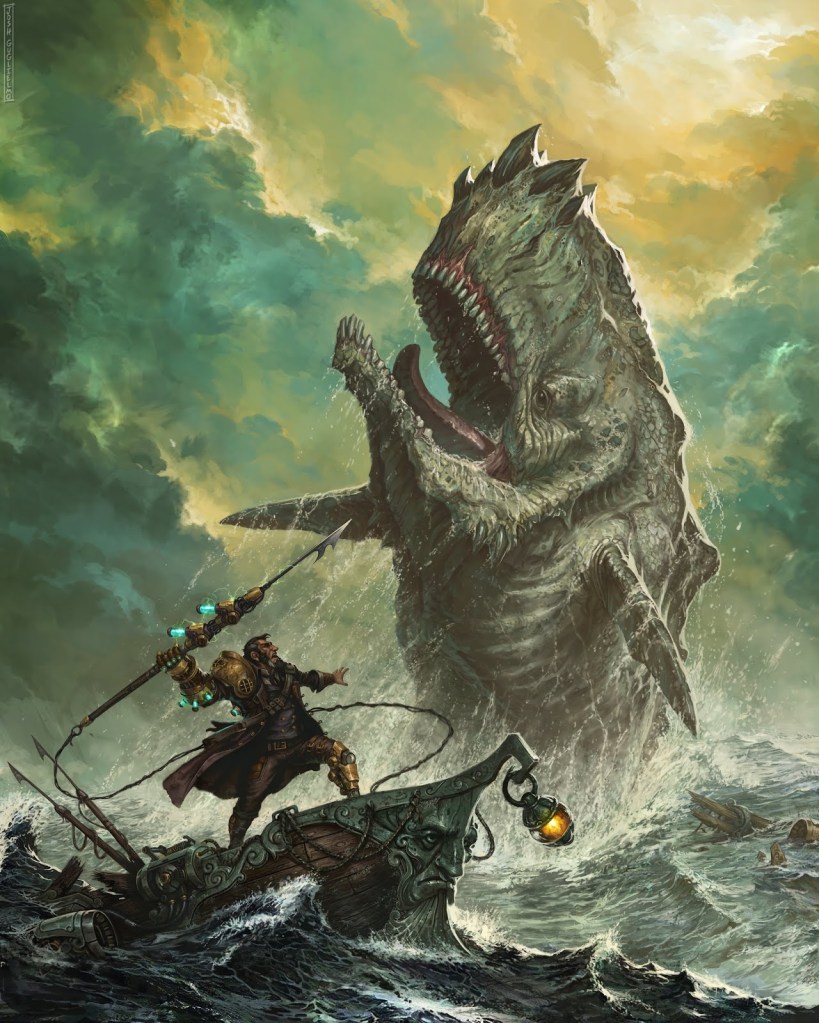
Unfortunately for the ol’ guy, this is kind of playing directly into the whalers’ hands: they know how to handle an aggressive whale! It’s their whole job! When it comes to actually evading and striking back, they have no trouble at all. The thing that bedeviled them last time was that the whale was too close! They couldn’t attack without risking the lives of everyone in Ahab’s boat, including the captain.
No, the thing that turns the tide in the end is their own lines, all now attached to the whale. This allows him to destroy two of the boats by simply running away, and then it’s easy to flip the third over with a quick feint underwater. Moby Dick has an enormous advantage over the crew of the Pequod: he is in his element. He can freely move down into the water and back up as he pleases. His power is enough to destroy them in an instant if he can only get into the right position.
What he lacks is perspective. The whalers have many eyes, acting as one great body as they are in this chapter, and can communicate with one another to track and surround him. Moby Dick must rely on his two eyes on the sides of his great head, as well as the physical sense of touch in his tail, in order to know what’s going on around him.
Thus, we can liken this deadly combat to a cow whipping its tail to get rid of biting flies. He thrashes around a bit, dips underwater, then swishes his tail for a while, and continues on about his business.
The Riddle
So: what exactly is the thing that vexes Ahab so, in the latter half of this chapter?
Well, it all comes back to that Shakespearean prophecy that Fedallah gave him a while, back in chapter 117, summarized as:
- Ahab will have no hearse or coffin
- Before he dies, he will see two hearses on the ocean
- The first that has been wrought by no mortal hands
- The second made from wood grown in America
- Fedallah will go before Ahab in death, as his pilot
- Only hemp may harm Ahab
Here’s the relevant quote for #3, from chapter 117:
“And what was that saying about thyself?”
“Though it come to the last, I shall still go before thee thy pilot.”
“And when thou art so gone before—if that ever befall—then ere I can follow, thou must still appear to me, to pilot me still?—Was it not so? Well, then, did I believe all ye say, oh my pilot! I have here two pledges that I shall yet slay Moby Dick and survive it.”

Back then, Ahab only interprets this as good news! He can and will kill Moby Dick, and won’t die, because it would be impossible for this prophecy to come to pass during this voyage. As long as Fedallah lives, he cannot die. But now, one part of that mystical armor has fallen away: if Fedallah is dead, then Ahab must be soon to follow, or else the whole prophecy is in question.
If this is to be part of his invicible armor, part of the legend that the old man shrouds himself in to maintain his perfect confidence, then it must not have any gaps or flaws. The death of Fedallah is either proof that it is wrong, and thus he is in mortal danger, or else it is proof that his doom is at hand sooner rather than later, if it is to be fulfilled.
Just look at how desperately it drives the committed Ahab, even as he was confidently throwing away Starbuck’s warnings once again:
The things called omens! And yesterday I talked the same to Starbuck there, concerning my broken boat. Oh! how valiantly I seek to drive out of others’ hearts what’s clinched so fast in mine!—The Parsee—the Parsee!—gone, gone? and he was to go before:—but still was to be seen again ere I could perish—How’s that?—There’s a riddle now might baffle all the lawyers backed by the ghosts of the whole line of judges:—like a hawk’s beak it pecks my brain. I’ll, I’ll solve it, though!
He wants at once to dismiss notions of supernatural doom, while he clings to one in his heart of hearts as justification for his actions. Ahab is quite lucky that nobody else knew of that prophecy, or he’d have a real mutiny on his hands!
The Mechanical Mastery of Nature and Man
There’s an interesting thread in this chapter, one that runs through the whole book as a subtle theme, I believe. That is: total control over natural things through the medium of mechanical action.
It first shows up in one of the early paragraphs, where Ishmael is describing how Ahab tracked Moby Dick’s course:
And as the mighty iron Leviathan of the modern railway is so familiarly known in its every pace, that, with watches in their hands, men time his rate as doctors that of a baby’s pulse; and lightly say of it, the up train or the down train will reach such or such a spot, at such or such an hour;
By observing nature actuely and with much time and experience, it can be predicted and controlled in the same way a train can. A complex problem is reduced to simple math: moving at x speed over y time, it will be at such and such a position in space. Even the mysterious leviathans of the deep can be understood at such a deep level that they may be predicted with such ease, if you work hard enough at it!
Then, later, during Ahab’s reponse to Starbuck’s latest plea:
“[…] This whole act’s immutably decreed. ’Twas rehearsed by thee and me a billion years before this ocean rolled. Fool! I am the Fates’ lieutenant; I act under orders. Look thou, underling! that thou obeyest mine.
[…]
D’ye feel brave men, brave?”
“As fearless fire,” cried Stubb.
“And as mechanical,” muttered Ahab.
This whole obsession with the prophecy, and confidence in his own prowess, is an expression of this same belief that Ishmael has. That the natural may be put in order and controlled, that we can know something of the future based on the past. Prediction is possible, it’s only a matter of having access to the right information, and having the will to use it.
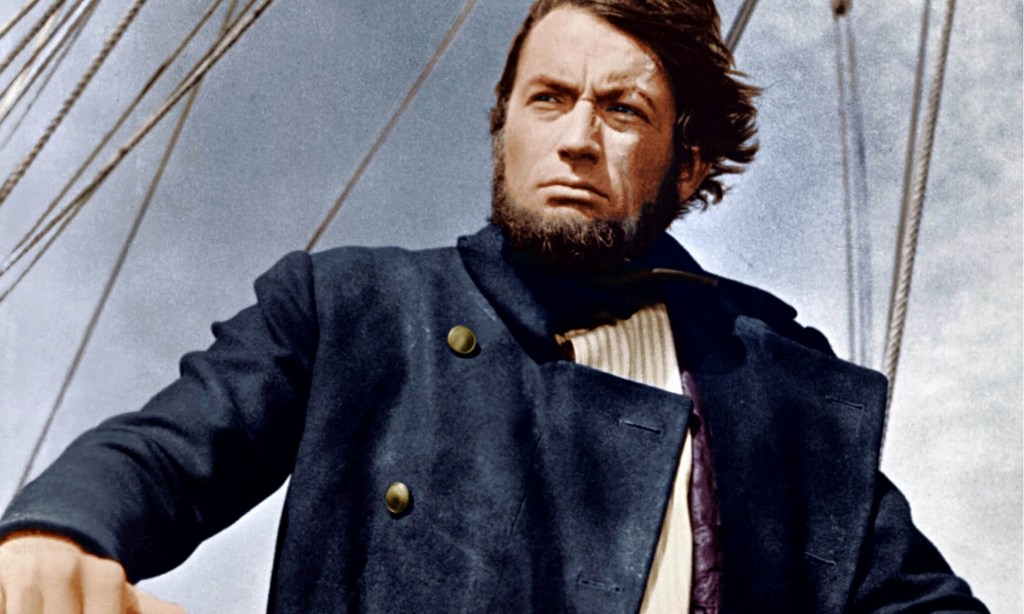
This sort of belief in individual power, in the ability to overcome any obstacle through sheer will and nerve and rationality, is central to Ahab’s approach to every problem he encounters. When faced with a potential mutiny in his crew, he treats them not as people, but as levers to pull, things to be pushed and prodded in the right ways to achieve his ends.
To bring things back around, at long last, to capitalism: this is the same philosophy that drives that economic system ever forwards and ever deeper to new depravities and cruelties. Not collaboration, not working together to solve problems; it is this desire for mastery and control and predictability that drives the engines of production forward.
Push aside happiness and warmth! It isn’t worth as much as your own pride, your own ability to control the world around you, to reduce it to a series of levers and pulleys. The key difference between Ishmael and Ahab is that the former is in awe of nature, finds infinite complexity and wonder in it, while the latter only sees another challenge to be conquered.
“All visible things are but pasteboard masks”. One could say that Ahab has the same spiritual view of the world as Starbuck, only he thinks that nobody can ever hold authority over him, not even God. And so he seeks to master even his own fate by turning it into yet another riddle to be solved, another mechanical puzzle.
Hoo, man, there’s just… so much to go over here. This isn’t even really getting into analyzing the language itself, which is some of the best in the whole book. Like I said, really going full Shakespeare. I loved this bit of alliteration:
I’ll ten times girdle the unmeasured globe; yea and dive straight through it, but I’ll slay him yet!

Also just… the way that Ahab is finally, finally breaking. The way the tragedy is made all the sweeter by the fact that it still isn’t too late! Starbuck makes his final appeal, and Ahab even seems to be considering it before denying it again.
On tumblr, in recent months, I’ve seen some people shipping Ahab and his first mate, but I didn’t really see it. After the last few chapters, it makes a lot more sense. At the very end, there is some special connetion between those two, though it may never been consummated in this tome.
We now stand at the place where the rubber meets the road, the prophecy meets its test, and the true nature of the world floods forth from beneath the mask it wears. The deadly nature of the whale fishery has been an abstraction this whole time, but we now have our first confirmed fatality in Fedallah.
Alas, Ahab doesn’t know he’s in a book, and thus the prophecy must be fulfilled, or it wouldn’t have been written that way in the first place. The whole thing is an invention of Old Ishmael, to give the tale some gravitas, and explain the seemingly mad actions of his captain. The question that remains is: how? By what means will Ishmael square this circle? Well, next week we shall all find out.
Until next time, shipmates!

 The Beige Moth
I finished reading Moby Dick last week (for the first time in about fifteen years) and the experience of reading it was enormously improved by reading your blog posts alongside it. I’ve really appreciated your thoughts and insights, particularly the anti-capitalist readings. You really helped elevate my existing appreciation for the book, and I’m looking forward to what you have to say about the very end. Congratulations on almost finishing this project, I’m positive that it’s going to remain very valuable for Moby Dick readers in the future as well. Thanks so much for taking the time to share!
LikeLiked by 1 person
[…] Moby Dick's aggression is significant because it highlights the whale's awareness of its pursuers and its efforts to discourage or kill them. This aggression plays into the hands of the whalers, who are skilled at handling such threats. Moby Dick's Aggression […]
LikeLike