
Ugh, once again I have been offended by that great, terrible orb in the heavens.
We had some hot weather here the last couple days, is what I mean. Not too bad, not over 90, but it was the first time in my new apartment, and it turns out that sea breeze does not make as much of a difference as I hoped. My new fan performed admirably, though. But still… I may need to invest in some conditioned air, at some point in the future. Well, let’s get to it.
Summary
Ahab hesistates, then approaches Perth, the blacksmith, and after some banter, asks him to forge a new harpoon, for his personal use.
First, Ahab hands over the stubbs of racehorse shoes, extremely fine and hardy steel. He instructs Perth to make the harpoon from these, after first making a strong haft from twelve rods of iron. Ahab himself hammers these together. Then the blacksmith forms the head into an arrow-ish shape with the steel from the horseshoes.
That done, Ahab hands over his razor blades, saying they should be used to make the barbs on the harpoon, so that it may never lose its grip. Perth completes this, but before he can quench in the final time in a barrel of water, Ahab calls over the three harpooneers, asking them to quench it with their blood. Cutting each on the arm, he collects a small amount, and pours it over the red hot steel, baptizing it in the name of the devil.
Finally, they set the harpoon in a pole, lashing it as tight as possible with twine. As Ahab makes his way back to his cabin, thudding along with his new ivory leg and steel weapon, Pip looks on and laughs.
Analysis
This chapter is another one of the more famous scenes, which kind of feels like it comes out of nowhere. Pretty sure this makes it into the film adaptation, the image of the pagan harpooneers quenching the new harpoon with blood is pretty cinematic.
But what’s actually goin’ on here? Ahab is forging some sort of legendary weapon from special materials… but that’s more mythologizing from Ishmael, really. We’ve seen plenty of that. The more interesting thing, I think, is the conversation with Perth, the blacksmith.
Misery Loves Company

We start things off with Ahab trying to relate to Perth, assuming that he is on the same basic trajectory. After all, has he not also endured the unendurable torments of tragedy and loss? Was he not also physically maimed by his sorrows? In the last chapter, one of the bits of information we get about the blacksmith is that he lost the toes on one foot to frostbite, as a result of his drinking.
Ahab senses a kindred soul, and prods him a bit, in his usual way.
“Well, well; no more. Thy shrunk voice sounds too calmly, sanely woeful to me. In no Paradise myself, I am impatient of all misery in others that is not mad. Thou should’st go mad, blacksmith; say, why dost thou not go mad? How can’st thou endure without being mad? Do the heavens yet hate thee, that thou can’st not go mad?—What wert thou making there?”
He is actually disappointed that Perth is merely going on about his life normally, not driven to madness. Indeed, the steady work of the forge seems to have a stabilizing effect on the man, he’s become inured his own sorrows.
Indeed, throughout the scene Ahab is blasted and recoils from the heat and steam of the forge, while Perth never makes note of it, kind of joking along with Ahab’s strange mutterings. He has actually endured the fires of hell, for years and years, and is not going to go mad at this point. He’s beyond that point.
In some ways, it gives lie to Ahab’s true madness, that he’s doing this in a fit of pique, without any real foundation. In the end, it’s a doomed mission, building it up into some epic, heroic quest is not going to change that.
Magical Practicality
I know I’ve written about magical thinking before, but there’s an interesting variation on it in this chapter. True, Ahab takes up the forge himself and gives special instructions, and finally baptizes his new blade in pagan blood in the name of the devil… but also, he makes sure it’s actually useful as a tool, before all that.
Using hoseshoe stubs and razor blades is not magical thinking, that’s just the best steel you can get your hands on. That is the part that impresses Perth, or makes him concerned, these practical aspects, not the mysticism of the moment. He is impressed by the horseshoes, and then concerned about destroying the razors, but Ahab insists he’s given up on shaving, at least until he kills the white whale.
Really, it undergirds a lot of Ahab’s actions so far. He is consumed with his quest… but not completely. Not totally mad, not completely gone. After all, he didn’t actually shoot Starbuck a few chapters back, and did agree to suss out the leak instead of admitting that he didn’t care about the oil to the whole crew. And here, he’s not insisting that the blacksmith go mad along with him, just kind of joking along.
It’s interesting, you can really see how Ahab is like… a charismatic leader, in these past couple chapters. Sure, he’s a bit odd, but he’s also easy to get along with. He’s not acting unreasonably, just very theatrically at times, which I’m sure nobody minds as long as he’s in a good mood (that is: not angry and punishing people, not setting arbitrary rules, etc).
An Incomplete Fall
His strategy of couching this quest for revenge as a relatable goal for other whalers, and giving them a monetary reward to aspire to, serves to solidify his position, and signal that it’s all in good fun.
And yet, at the same time, we have the symbols of madness (Pip) and spiritual darkness (Fedallah) haunting him, stalking nearby. While Ahab plays at abandoning his faith completely, baptizing his blade in the name of the devil with pagan blood, he still clings to it by calling upon the power of its opposite. Must not one believe in god to be a satanist? Only someone with faith would imbue those latin words with power, after all.
Fedallah is the real deal, in that regard. As a “Parsee”, ie a Zoroastrian, he is a member of a more ancient faith, predating Christianity by centuries. He has no regard for these latter languages and their magic words. There is something older and thus more authentic in his darkness than Ahab’s.
In the same way, Pip’s madness is more complete than Ahab’s. Staying sly and strategic in how he reveals his inner thoughts to the crew, he maintains his wits, still struggles over delving deeper into “mad” actions. He was injured, but his response has been long reasoned and carries a metaphysical strategy to it, striking back against the forces of fate that offended him.
Pip, meanwhile, has lost his reason, due to an extremely traumatic event, plain and simple. He is not filtering himself, he is lost completely in his own world. There is no strategy, no cunning to his actions, because he wouldn’t even consider it.
To bring a Shakespearean connection, Ahab is a bit like Hamlet. He’s seeing the ghost… but he doesn’t quite believe what is says. He has not given over to the world of the phantom and fantastical, he must have solid evidence and take care of practical concerns. He’s forming plans and plotting to get his way, not merely pursuing what he believes in his true heart of hearts.
Stray Allusions
I feel like I’ve been falling down a bit in this area lately, but I was so curious about a couple things I had to go look ’em up.
First: What the heck are Mother Carey’s chickens?
“Are these thy Mother Carey’s chickens, Perth? they are always flying in thy wake; birds of good omen, too, but not to all;—look here, they burn; but thou—thou liv’st among them without a scorch.”
Turns out this is a type of bird, also known as the storm petrel. They were considered a good omen sent by the Virgin Mary, meaning a storm would not be arriving soon. The original name was “mater cara”, and it was twisted over the centuries into “Mother Carey”.
Second, the actual translation of the dang latin in this chapter, which was a little annoying to track down. People love to talk about latin phrases like any idiot could figure out what it means. After all, every educated person still learns latin, right?
Anway:
“Ego non baptizo te in nomine patris, sed in nomine diaboli!”
This means: I baptize you not in the name of the father, but in the name of the devil! Which, in retrospect, I probably could’ve puzzled out, huh. Oh well, nice to have it spelled out, it’s a very… direct implication.
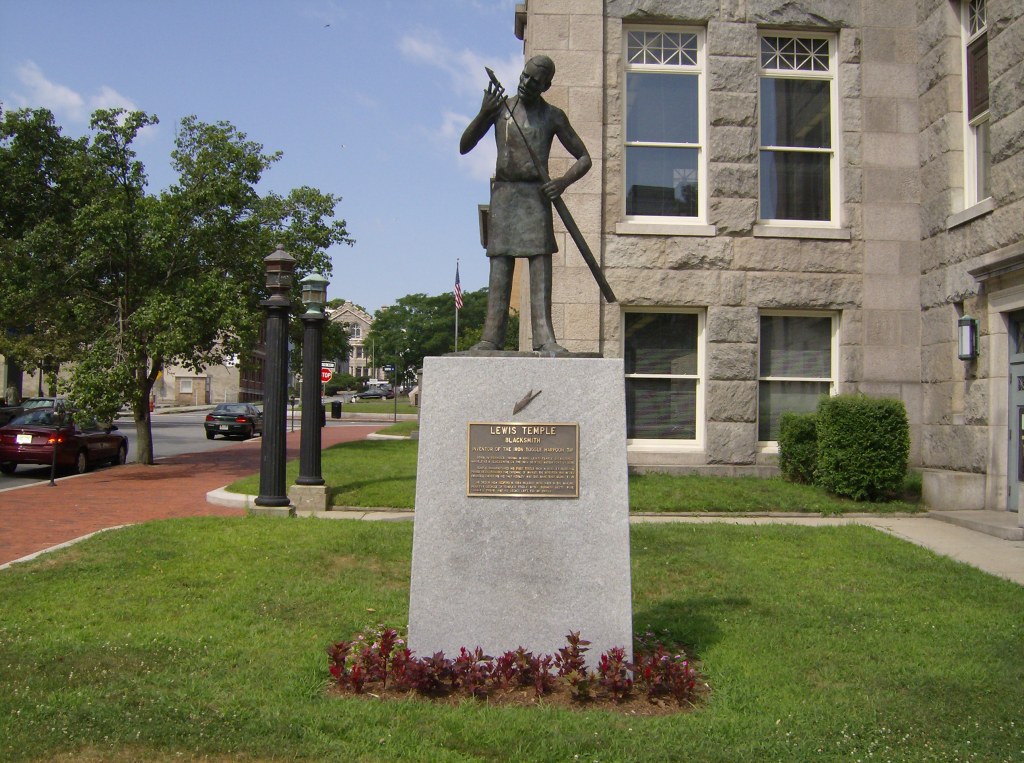
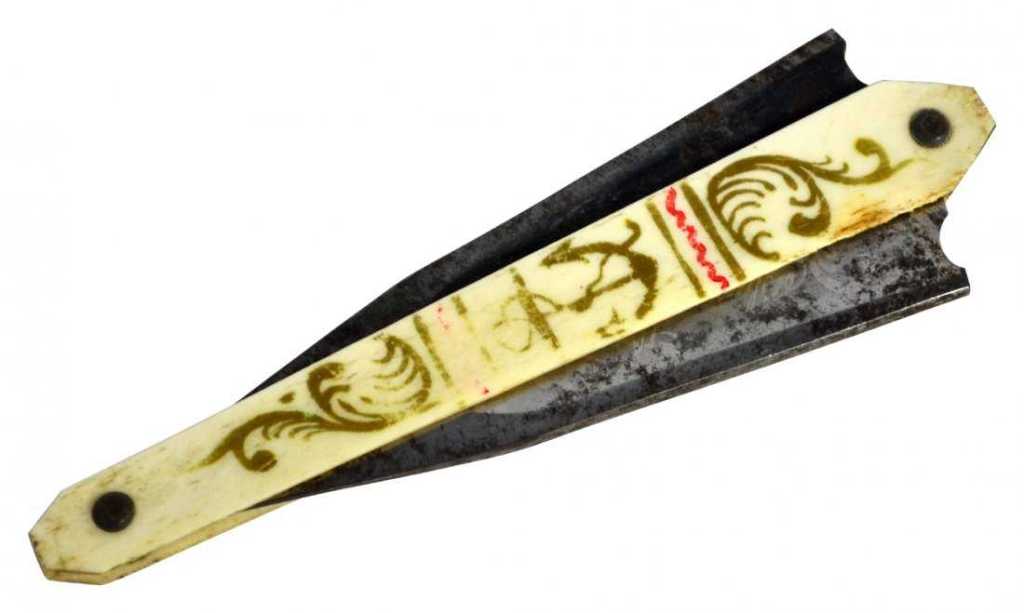
Finally, a very interesting tidbit I got from a comment on the last post, which is the specific type of harpoon being made here. By happenstance it’s the exact one I grabbed a random image of for last week’s post. It was designed by Lewis Temple, a Black blacksmith in New Bedford, a new variation on an ancient concept. It was even named for him, Temple’s toggle. It’s designed to be able to “toggle” to a different position after finding purchase in its target, thus becoming harder to remove.

Temple’s story is a simple and yet tragic one. Born in slavery, he found success as a smith in the northern city, innovating in harpoon design as he did. But he was injured by some shoddy construction, successfully sued the city… but died before he could collect, and then faded into obscurity.
I apologize for being a day late with this one, I felt I needed some extra time to chew it over in my mind. I think there are a lot of allegorical readings one could make of Perth, and I’m certain that people have, particularly with his small amount of page time and enigmatic conversation with Ahab.
We’re really moving into the final arc of the story here, as things shift to build up the final confrontation. Things are going to be even more heavy with portent than ever before. Much to think about.
Until next time, shipmates!

 The Beige Moth
Great Post Again.
LikeLiked by 1 person
Great observation about Ahab and his “madness”. I too was struck by 1) how chipper he was toward Perth (even though he couldn’t drag Perth into the mud, so to speak, to call himself mad–though Ahab does find a better kindred spirit in a few chaps, doesn’t he…); 2) that Ahab conceded to Starbuck and let the crew suss out the oil leak (a few chaos earlier); 3) bribing the crew with the doubloon (and even more $$ in a few chaps). I haven’t heard/read anyone else pointing out these contradictions.
LikeLiked by 1 person