
The last day of my vacation has come, and I decided to take advantage and write one more post, for now.

The damnable summer heat has finally abated, somewhat. The famous clouds of my homeland have returned, if not the more-famous rains. But I know that they shall, in the fullness of time. I can only hope we don’t suffer from awful wildfire smoke this year (knock on wood).
Summary
Old Ishmael considers the question of whether whales have grown smaller over time. On the one hand, all the fossil evidence discussed in the last chapter indicates the opposite, whales today are larger than ever before, and indeed the more recent whale remains are always larger than the older ones. On the other hand, Pliny the Elder and other ancient naturalists boast about truly enormous whales, measuring hundreds of feet in length.
Ishmael concludes that those ancient naturalists are a bunch of liars, and believes the hard evidence of his own experience, stating definitively that whales have only grown larger over time.
Next, Ishmael considers the question of whether whales may go extinct (though he does not use that term) at some point in the future. After all, the mighty buffalo once ranged all over the vast plains of America, and was hunted to extinction in a few short decades. With more and more whaling ships scouring the oceans, surely the whale may share the same fate?
This argument is rejected, on the evidence of:
- Whaling ships kill far fewer whales in the same time period compared to buffalo hunters
- Whales are changing their activity in response to being hunted, going about in bigger groups that are harder for whalers to deal with (as we’ve seen!)
- Whales are free to move around to different parts of the ocean if they are being hunted, so failing to find them in one place does not indicate that their overall population has declined
- They can hide in the polar regions, where whalers cannot follow
- The population of whales is vast and they are so long lived that it is impossible for us to accurately gauge, and the fact that so many of them are fully grown adults means that they can easily recover their population if it does decrease
In conclusion, the whale is immortal and eternal.
Analysis
This is another one of those chapters that people like to point at and say “look at this idiot!”, because Ishmael is ignorant of the true destructive potential of humanity.
But, I mean, his arguments may not stand up to the test of time, but also… he’s not wrong. Whales have not gone extinct. It’s just not for the reasons that he states here. Let us go through his arguments, and then take a look at some of the reasons that these leviathans do, in fact, still swim the seas.
The Tragedy of Industrialization
The main thing that Ishmael failed to predict is the invention and widespread use of two technologies in whaling: steamships, and exploding harpoons. If you’ve got a gigantic boat that moves on its own, not at the whim of the winds, and you have harpoons that can kill a whale every single time, you can do whaling on an industrial scale. And, indeed, that’s exactly what happened.
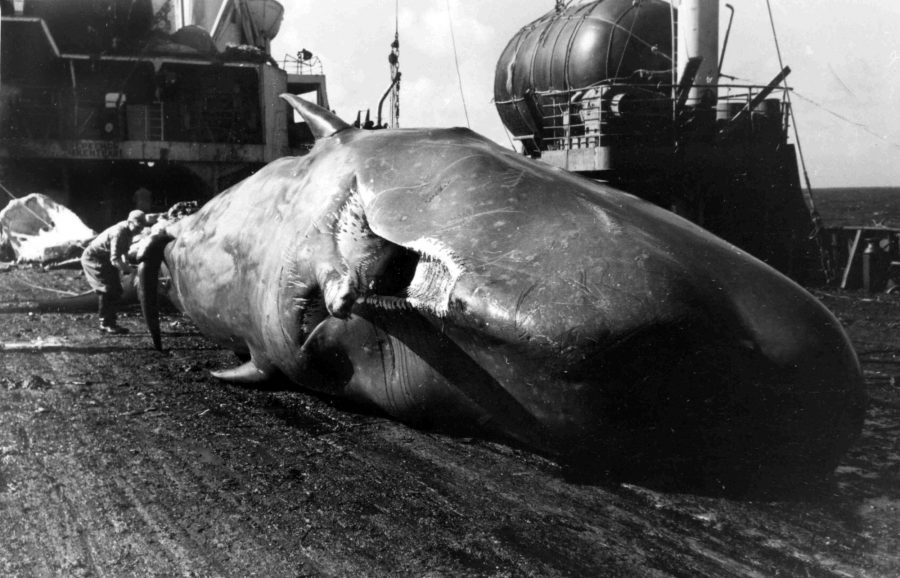
Whale oil was still a valuable commodity, along with blubber and meat, and so whaling continued well into the 20th century, and did in fact severely deplete the population of several species. The sort of artisanal whaling that Ishmael (and Melville) practiced was no threat, he wasn’t wrong about that part, but he lived on the cusp of an explosion of technological progress unprecedented in human history, which we are still in the midst of.
Industrial whaling ships were much larger, and much more efficient, so they could in fact kill many dozens of whales with ease, on every single voyage. They still didn’t quite approach the efficiency of buffalo hunters, of course, but still, their reach extended much further and was much more deadly than could be anticipated.
Mere changes in behavior could not save whales. Larger herds were simply bigger targets. And whales are not as free to range where they wish as Ishmael imagined, the polar regions could not sustain them. They go where they do for concrete reasons, to feed and mate, not merely at a whim.
And Yet, They Persist
And yet, despite killing them on an industrial scale for decades on end, whales yet persist. And, indeed, their populations have recovered to a great degree, such that they are no longer considered endangered, but merely threatened by the IUCN.
The reasons for this are twofold: less demand, and human compassion. The usage of whale oil was reduced, as cheaper alternatives were found, and people came to regard whales as a kind of symbol of the environmentalist movement.

This was particular relevant because the American whaling industry had largely shut down by the dawn of the 20th century, but it continued in earnest in Russia and Japan (and some other South American countries). So, there was a movement to boycott products that included whale byproducts, or were from those countries that still practiced industrial whaling.
Eventually, this was successful in shutting down the industry pretty much altogether. Sure, there are some people who kill whales here and there, but largely smaller and more numerous species, and only in small numbers.
When I was a child, there was a great deal of controversy around a local Native American tribe, the Makah. They wanted to have a traditional whale hunt off the coast of Washington state. There was all kinds of hemming and hawing about it, how they would be allowed to go about it, how many whales they could kill, if it would be allowed at all.
In the end, they were allowed, and killed just a few. If I recall, they just went out on the water in little boats, and shot the whales with guns after spearing them in a more traditional fashion. Showcasing how modern technology makes whaling easier and more reliable, yet also relegates it to a sort of ceremonial practice rather than a commercial one.
Our Place In Time
Now that all the facts of the matter are established, it makes me think of the difference in how we see our place in the eternal march of history, in comparison with Melville.
The impression that I get, from this chapter and other bits here and there, is that people in the 19th century, and previous ages, saw themselves as being part of a grand, eternally repeating cycle. Empires rise and fall, things change, and it always comes back around the same way, in effect. There is some sort of grand plan, and everything is going properly, because it must.
You can see a bit of that with the argument in the first part of this chapter, where Ishmael argues confidently that whales have not diminished over time. There is this old notion that things were bigger in ancient days. Not just, like, more important, but literally physically larger. Including people! Like the idea was that those of Noah’s generations were like a hundred feet tall, or more.
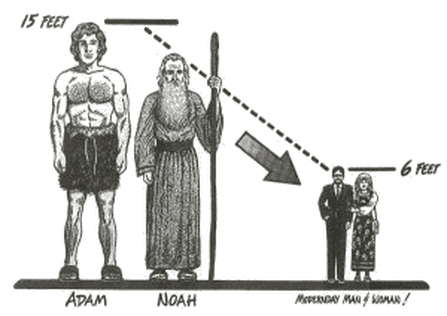
This goes way, way back, all those old legends and giants and whatnot, and takes many different forms. You still see the idea today in fantasy stories and among people who worship the past as a greater era. Instead of physical size, it’s more about living better lives or being more wise or whatever. You know, the old saw about some ancient civilization with advanced technology, or that the ancients foresaw our every move, or whatever.
In modern times, there is an alternate notion: we stand at the end of history. This term refers to a specific argument put forth by Francis Fukuyama in the 90s, after the end of the cold war. It seemed that things had been finally settled, and we were just going to see to fixing little problems and continuing to develop technology and understanding, off into a utopian future.

But I think it has evolved, over time, to be a more complex and far-reaching cultural notion. The idea that we are in an age of categorization, and figuring out the real truth of things, and simply setting down the laws of the universe. It’s a notion of anthropomorphized history as a sober adult, we’re done with all the foolishness of youth, all the wars and destruction, and are ready to just settle down and get the boring work done that needs to be done.
I feel as though this notion has haunted my entire life. Definitive statements about the world abound, and it seems to stultify creative expression and exploration. Going and doing culture is no longer vital. We will celebrate the cultures of the past, sure, we will sit down and study things that have happened, but we are beyond that struggle. We stand removed, aloof, pseudo-mechanical janitors and guardians of knowledge.
Struggle On!
Of course, this is all nonsense. Life continues on! People are still struggling and striving all over the world. We still languish beneath the heels of various oppressive powers, and it is in their interest that we would count all struggles for freedom and justice completed.
We are still living in the real world. There is yet time to improve and perfect human society and existince. We are not trapped in some immaculate plan, and Ishmael’s revolt against the supposed wisdom of the ancients is evidence of that. Conventional wisdom of centuries is overthrown by a simple man believing his own eyes against their solemn proclamations.
So let this be the moral you take from this simple, funny passage:
But will any whaleman believe these stories? No. The whale of to-day is as big as his ancestors in Pliny’s time. And if ever I go where Pliny is, I, a whaleman (more than he was), will make bold to tell him so.
Trust your own judgment, what you can see with your own eyes and what your own logic tells you. Resist fallacious appeals to authority and conventional wisdom. And listen only to those with hands-on experience of which they speak.
Ah, always fun to go off on a wild tangent and find words for something I’ve been trying to articulate for years and years.
But where does that laste sentence leave me? Well, it’s quite simple: you can trust what I say, as I am a person with a lot of experience reading this book. And, I have exactly as much experience with 19th century whaling as anyone else alive today.
Until next time, shipmates!

 The Beige Moth
It seems to me in this chapter, Ishmael, like a devoted worshipper arguing for the truth of his god, presents rational reasons that the whale will continue to exist, but when reason threatens his argument in any way, he simply rejects “reason.” The whale will continue to exist because it must, because humanity requires whales in order to see itself in perspective. We are not captains of spaceship earth, but passengers, and we had better learn to mind our manners and get along. When Captain Arab kills Moby Dick, he will have destroyed meaning and awe and wonder. And where will we be without all of that?
In regard to our more modern fascination with and desire to protect whales, I’ve always suspected this book has had something to do with that. And, of course, the fact that hunting whales is no longer as profitable as it once was.
LikeLiked by 1 person
What a great analysis of a fascinating chapter. I love how we have sequentially dissected the whale from its genus, to it’s anatomy, to it’s bones, now to it’s place in history. Reading this book for the first time alongside your commentary has been one of the most rewarding reading experiences I’ve ever had – thank you.
LikeLiked by 1 person