
Recently, I engaged with two works of popular, mainstream art that both carried with them a message of deep pessimism, which was somewhat unexpected.
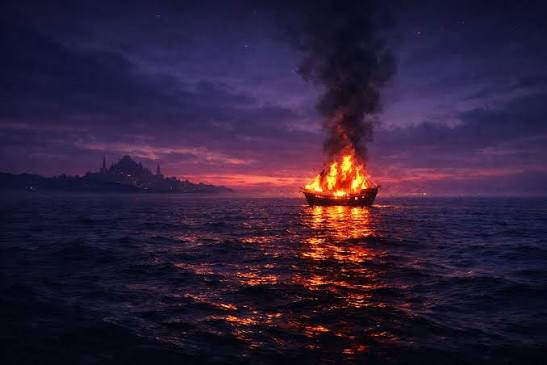
One was a book, and the other a movie. One was focused on the leaders and the broad shape of society, and the other was much more grounded, focused on the individual experience. One was a murder mystery, and the other an epic adventure story. Both are very clearly relating to the specific experience of living in America in 2026. I’m talking, of course, about The Odyssey and A Trade of Blood.
This feels noteworthy to me, as I haven’t really heard much discussion around these themes. Admittedly I haven’t really been paying attention to any potential discourse around A Trade of Blood, I’m not really in “book circles” in any social media. All I’ve heard is “it’s good”, which it is! But all the endless discourse over the summer relating to The Odyssey was all about how faithful it was to the original text, or about the casting of black people as ancient Greeks. Which was all extremely tiresome.
It’s not particularly surprising that people are feeling down about the current moment in history (lord knows I am), and it’s interesting to see how artists are responding to that. So, I’m gonna write some thoughts about it, analyzing how those themes come through and what I think they’re about.
The Odyssey
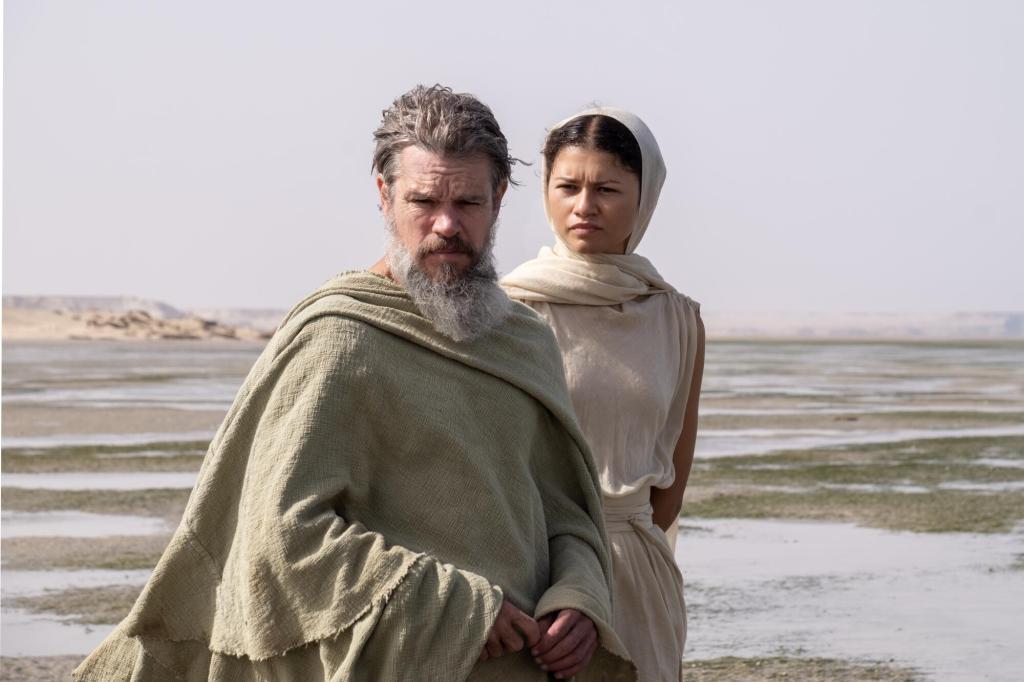
There have been many adaptations of The Odyssey, but I’m talking about the big blockbuster version directed by Christopher Nolan, released in the summer of 2026, just a few months ago. I went to see it at the Pacific Place theater in downtown Seattle, not in Imax but in 70mm, and thought it was pretty good. Personally, my biggest complaints were the sound during the whole cyclops sequence being way too loud/discordant, and the action being shot in his same old shakey-cam style that prevents you from seeing what is happening. Nolan was apparently inspired by Ran (1985), but he should’ve taken some notes from how Kurosawa shot his action scenes, is all I’m sayin’.
As has been exhaustively established by many critics and scholars of different stripes, it is very different from the original, so I will give a spoiler warning for The Odyssey (2026) from here on out!
This movie strikes a very pessimistic tone, especially towards the end. Odysseus and his crew make their way across the Mediterranean, having adventures, but mostly running into different types of hostility. First they come to a sea village and pillage it, taking supplies and burning it down, since they find the inhabitants have already fled, preemptively treating the Ithacans as dangerous enemies.
Odysseus meets one of the villagers, and is surprised that they are so fearful, since they’re both Greeks, and they wouldn’t have attacked the village if they’d known. But it turns out this is extremely important to the central theme of hospitality, or “Zeus’ law” as they say one million times throughout the picture (Nolan’s scripts are never the best (it’s properly called “xenia” but whatever)).
The long and short of it is this: people are more and more paranoid about attacks from the mysterious “sea peoples”, which is a real hypothesis about the bronze age collapse. But in the end, it turns out that the rumors of the sea peoples were caused by Greeks crimes during and after the Trojan war. Represented by the Trojan Horse, which was left as a gift but actually contained soldiers, leading to the downfall and slaughter of Troy, rendered here as a sort of early ’00s war crimes montage.
This founding myth of so-called western civilization, the glorious conquering of the enemy with the help of a brilliant trickster, was actually a deep betrayal of their moral code. That’s the way it’s being framed, anyway, just roll with it. This abandonment of values has caused a moral rot and general dissolution of the very alliance that allowed for the great victory in the first place.
This theme of betrayal underlying the victory that people are supposed to be celebrating, undercutting the famous story that everyone knows, is baked in throughout the movie. You get it with the Trojan horse, with Odysseus killing the priestess of Athena, with his crew eating the cattle of Apollo, so on and so forth. You can quibble with any bit of it, and people have, but it all adds up to this: things are falling apart, and it’s our fault.
This moral rot is portrayed not as the fault of any one person, but it does start at the top and trickle down, so to speak. Odysseus, obviously, but also Agamemnon, who is killed by his wife for sacrificing their daughter just so he could launch the Trojan war fleet.
The whole storyling with Telemachus is also rife with this kind of thing. The suitors, who didn’t even go to war, are abusing hospitality. Both taking too much without reciprocating, and also denying it to people they find unworthy. Abusing the beggars, the people actually in need, who come to the palace in Ithaca. They are, of course, the upper classes of nobility.
Some people got very upset over this theme, because it is not at all present in the original work, which is basically a completely uncomplicated story of a cool hero who won a war and then got into a bunch of wacky adventures. But let’s pause and think: why was this? The original Odyssey was a story about a past golden age, it wasn’t composed at the same time or in the immediate wake of the actual Trojan war.
It was a story about the good times that have been lost. Telling stories about how good and smart your ancestors were, how good things used to be before they got ruined by modern people, so on and so forth. But Nolan’s Odyssey is more along the lines of a revisionist western. Taking those myths and saying: wait, what are the values this thing is espousing? What would this actually look like?
It is essentially Nolan doing his same grounding maneuver that he did on Batman back in 2004, but with Greek myth. Taking a thing that everyone sort of treats as a frivolous genre object and saying “hey, what would this actually mean if it was real?” Which I find really fun and interesting, but obviously rubs some people the wrong way.
This leaves us with the essential question: how is this theme related to the contemporary American experience, specifically?
Well, we are currently living through a revival of fascism, and it feels like institutions are slowly collapsing left and right over petty grievances and moral rot. Racism, sexism, and transphobia are the official policy of the United States and United Kingdom governments. Especially in the wake of the 2024 election, there was a sense that things are getting worse, not better, and that feeling itself has only intensified in the past two years.
It is also, I think, related to the fallout of COVID. People in white, upper class circles are more paranoid and antisocial than they’ve ever been before. There is a sense that we cannot have anything good not because it’s impossible, but because it’s just not worth trying. That people are just monsters and there’s nothing you can do about it, so just crouch in your little suburban fortress and prepare to defend against the coming horrors as best you can.
Now, I can already hear people responding to this with “this isn’t new, it’s been that way for decades”, to which I respond: yes, but it’s now gotten so loud that a movie espousing pessimism and despair over this viewpoint made a billion and a half dollars. The background noise has become too loud to ignore. This is a vital backstop to the back-patting head-in-the-sand stupid optimism of the current day fascists (which are still, in the end, part of a death cult).
Nolan’s pessimism, in my view, boils down to: Our society is falling apart because our leaders are losing their minds and have completely abandoned the moral framework that built all of this in the first place. It is, really, a very practical and utilitarian view on morality: we had a good thing going, and you idiots are ruining it. Taking care of people and not being bigoted simply produces better results, but our idiot leaders are high on their own ideology and want to just crush the lower classes (another COVID hangover, of course).
It’s partially fear of the imperial boomerang, but more generally a sense of defeatism. A sense that the battle has already been lost, the vibe has shifted, we can’t fight our way back. We can only wait for the inevitable collapse and hope that future generations can rebuild something good from the ashes.
By looking to the past, Nolan does allow for some hope. After all, the bronze age wasn’t the end of history. There were all kinds of different ages after that! But he is definitely saying that shit right now is totally fucked, and there’s not much we can do about it. The Odyssey is concerned with the boat, and the fact that the captain may have gone insane.
A Trade of Blood
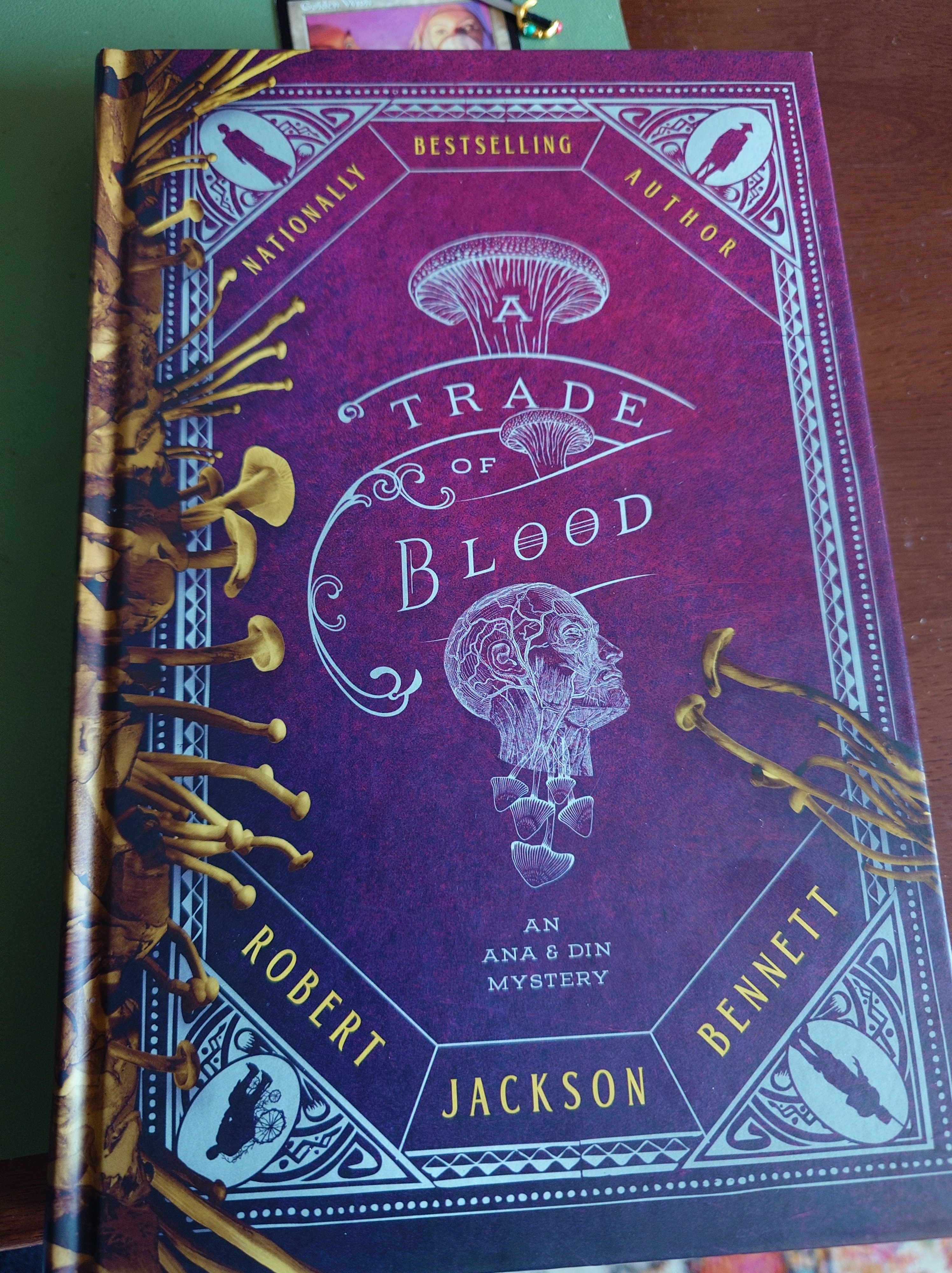
Alright, this one probably requires a little bit more explanation.
The thing I’m talking about is the latest novel in the Shadow of the Leviathan series, also known as the Ana & Din mysteries, by Robert Jackson Bennet. It came out last month, and I absolutely devoured it over the course of like three days.
I’ve written here about this series before, mostly about how it struck me as a little fashy. I think that’s mostly gone away with this latest novel, and if anything does point to how both fantasy and detective mystery novels are somewhat conservative at their core.
Anyway, spoilers from here on out for A Trade of Blood!
So, in this novel Ana Dolabra and her erstwhile assistant Din travel to Fantasy Texas, aka the canton of Sapirdad, inside the third ring wall of the great empire of Khanum. I was kinda hoping we’d get closer to the heart of the empire in this one, but it turns out it’s not the finale of the trilogy, just the next story in what could be a very long-running series. I suppose it’s more of a mystery than fantasy, in that way.
I call it “fantasy Texas” because it’s cattle country! Could also be the Fantasy Pampas, I suppose; this series does feel like it has a bit of The Book of the New Sun in its DNA. It’s hard to say for sure, I can’t recall if we’ve learned if it’s warmer in the North or the South, the series is so utterly unconcerned with anything going on outside the borders of the empire (or right next door).
In keeping with the sort of bio-punk setting, the people of Sapirdad have figured out how to grow their cows to truly enormous size, and also how to use a certain fungus to mind-control local cat-like creatures (but with creepy human hands) to harvest cattlefeed.
The plot mainly concerns someone using a variant of this mind-control fungus to kick of a conflict between the two most powerful ranching families, ending with almost all of both families dead. No need to get into the nitty gritty details, but it’s got to do with gender and resentment over freedom and whatnot. There’s an abortive Romeo and Juliet situation at the core of it, which kicks off the whole thing.
Anyway, I mostly want to talk about the big revelations at the end, which give the book its peculiar flavor of pessimism. First, that the mind-control fungus was not altered to work on humans, it was originally designed for humans and had to be altered to work on cats (not the other way around). And secondly that the legendary founders of the Khanum empire were far more monstrous than previously thought, both in appearance and in actions.
It turns out the local ancient people, who are worshiped as gods, invented the mind-control fungus and used it to enslave the local humans, to do their bidding. Din delves deep into a spooky cave and finds an enormous cistern, where they still labor even beyond death, their bodies forced to perform the same actions for eternity by their ancient masters.
Now, the actual Khanum destroyed these other ancestral people, and sealed away this fungus, for some reason. We’d like to think it’s because it was a monstrous practice, but it’s not actually clear.
We also, through Din, get a clearer look at what the ancient Khanum looked like, and it was… weird. Elongated heads, extra fingers, they altered their bodies a lot, and in stranger ways than previously known. Ana hints again at her mysterious origins, as well, saying that she’s “seen stranger” after taking her blindfold off and looking at the statue.
Personally, I think it’s going to turn out that she’s a direct relative of the emperor, or some unfathomably high-class family that still practices these strange and extreme alterations. That was actually my theory when reading the first book, that she was a direct relative of the current emperor, it made a lot of sense, and it only makes more now.
Anyway! The bad vibes in this story are a lot more… individualized. It’s Din who’s feeling bad, here in the heartlands of the empire, seeing these petty ranchers killing each other, torturing animals, this whole industry built on death and horror and for what? So people can eat something tasty? They could get by on a vegetarian diet, lots of people do it out where he grew up.
You can really see where the author’s personal experience of living in Texas is informing this viewpoint, especially when Din is gazing at the heads of cows and bulls mounted on walls by the dozen and feeling distinctly creeped out. Not only that it’s a ghastly spectacle when you get down to it… but treating these living beings as trophies, as something you have personally formed over the generations into their current state.
The eponymous “trade” is not only the killing, but every aspect of husbandry. The cattle are altered to be unrecognizable, the cats are enslaved to enable this excess, paralleling the ancients doing exactly the same thing with humans, hundreds of years ago. Indeed, it’s noted how much control they have over the natural world, not only crafting this fungus but also creating this enormous forest that emits pheromones that drive humans away. There are paths… but they are very narrow, and can only be traversed with special equipment.
Yes, the big theme here is compulsion, control, and forcing your will onto another living being. The rich rancher families tried to use social control to keep things in line, but it doesn’t work, in the end. Kids will be kids, and you can’t control them perfectly… unless you’re willing to turn your tools of the trade on them, in one way or another.
Oh I should explain, briefly: One family figured out the way to make cows huge and got rich, and then the other family found the fungus and figured out how to use that to control cats to harvest beans to feed the enormous cattle, and thus also became rich. They each use their power to control the biological destiny of other living beings, just in different ways.
This whole situation, both being horrified to learn about the true decadence of your fellow citizens and also that the ancestors that so many of them revere were inhuman monsters engaging in even worse practices, struck me as very… contemporary. We are in a moment in history where the United States is slowly collapsing, all of our institutions being gutted and torn apart by inches.
First, there was a big dramatic attempt to burn everything down, but since then it’s been a sort of sustained campaign to make everything worse and do stupid shit that pisses everyone off, by the Trump administration. But rather than looking outward at how the international liberal order is falling apart, A Trade of Blood is looking inward.
Our practices are not sustainable, and people like it that way. Without immigration, our population would dwindle just like the empire of Khanum. There is no energy for positive change, only for clinging to what you have, or wreaking bloody vengeance on anyone you perceive as threatening your sense of complete control over reality.
This book looks around and says: this is all just kinda sad. We’re all going through the motions, some people trying to make the world a better place, but it can never be enough. Things are broken in a more fundamental way, and there’s no way out of the current situation for us, right now. Our society is the end product of a mind-boggling number of horrendous crimes, and here we are trying to solve the new ones that come along? What’s even the point?
I suppose the only way for a detective mystery novel to escape being somewhat reactionary is by taking a skeptical eye to the genre itself. This book does so in a very well-earned and subtle way. Fantasy too! So many fantasy stories talk about the wonders and wisdom of the ancients, but this is willing to say “wow those people back then were horrible”. Which is something that happens all the time in real life.
It’s impossible not to draw a direct line from the fungus zombie slavery of the ancients in this book to the chattel slavery of the United States. It hardly even needs to be said, but I figured I may as well say it. “A Trade of Blood” indeed.
Ahhh, man that felt good to write. I spend so much of my time being bombarded by various opinions on things, and so rarely take the time to voice my own.
If I had to wrap things up in a bow, I would say this: these are bad times, and people are making art reflecting that. Things have gotten bad in a way that is impossible to ignore, even in the fun fantasy lands of frivolous genre novels and popular blockbusters.
A few months ago, I noted that even the legasequel to The Devil Wears Prada had an anticapitalist message to it, essentially “the best a media company can hope for is to become the pet project of a billionaire who isn’t evil”. This stuff is in the air in a real way, which is… interesting.
Until next time, shipmates!


The Ana and Din books are my favorites of the fantasy genre
LikeLiked by 1 person