
Jimmy Cameron back at it again!

Well, I suppose he never stopped, really. This movie has been in the works for the last two decades, give or take, using a lot of material shot ages and ages ago. And boy, it really shows, sometimes. I had a lot of fun writing about the last Avatar movie, and I’ve got a lot of thoughts about this one, so let’s get into it!
I’d like to approach this movie from two perspectives. On the one hand, there’s the basic craft of filmmaking on display, which is very good. As always, the computer-generated imagery is insanely well-done and the 3D is the absolute pinnacle of the medium. There’s no denying that an incredible amount of effort went into creating this movie, it’s all there on the screen.
In other aspects, it is… somewhat lacking, and it is also jaw-droppingly racist, but we’ll get to that later.
A Muddled Do-Over
First off, let’s just talk about the plot. One of the main defenses of Avatar movies is that they’re “elemental”, they’re taking very basic plot ideas and characters and using them as a kind of framework for this world-building and graphical effects extravaganza. Thus: yeah the plot is kind of basic, but that’s not really the point.
The last two movies, that was a fair enough defense, but this one is really stretching it. It feels like at least two movies mashed together out of concern that they wouldn’t have the luxury of time to finish the story properly. So we get this mad rush to get back to a place we’ve been before.
Oh uhhh full plot spoilers for Avatar: Fire and Ash from this point forwards!!
Look, I’m a guy who can really turn his brain off and enjoy the pretty colors. I love a braindead action scene! I love a big clash of ideals that looks cool, even if those ideas are incoherent. The problem here is that we end up in the same place as the last movie: protecting whales by destroying highly industrialized whaling ships. There are no new ideas there, it even borrows the deus ex machina from the original movie.
The one new element, the Mangkwan or ash tribe, feels like an afterthought, and don’t really add a lot to the dynamic, ultimately.
There’s a very obvious stopping point in this movie, where the plot has kind of resolved but there are some lingering plot threads, and it’s after Jake Sully and Spider escape from the human city. That has a whole arc to it, getting in there and figuring out how to save them and whatnot, and it comes to a satisfying end, and then… there’s just like another third act bolted on. It’s jarring, and makes the movie feel five hours long.
After that is when you get the bizarre action scene where Lo’ak and his friends are chased by alien humboldt squid in the open ocean, which feels totally disconnected from anything. It’s an orphaned scene from a movie more built around trying to find the wayward and exiled Payakan that was largely scrapped when this monstrosity was frankenstein’d together.
More generally, the movie loses that silky smooth James Cameron plot flow, that characterizes most of his movies. Suddenly you don’t really know where you are or where you’re going. Is there going to be some sort of counter-attack? Are we really going to have the exact same finale as the last movie? Or is something radically different going to happen? It’s not clear, and that makes things feel like they are dragging and awkward.
Anyway, enough beating around the bush, let’s talk about the Mangkwan.
The Amalgamated Other
In the first Avatar movie, we were introduced to the Omaticaya clan of Na’vi, who live in… I guess just the forests of the planet Pandora. We learned about their ways and how they worshiped a sort of tree god called Eywa. It felt very appropriative of a wide variety of indigenous belief systems, particularly of North America.
In the second movie, we met the Metkayina, the water tribe who are basically space cat Maori. They live on the beach and are adapted to live underwater, and the film lingers and spends time explaining their society and how it differs from how the forest tribe works. This was at least a bit more specific, and it felt like they did their homework and made something that fits into the world more.
In this movie, we meet the Mangkwan, the ash tribe, and we don’t learn shit about them. They’re just evil Na’vi, embodying every single negative and conventionally “ugly” trope and stereotype about indigenous or nomadic people of the entire world, all at once. The only information we get about their circumstances is one line, which was literally in the trailer, saying that their spirit tree was burned down by a volcanic eruption and Eywa did nothing to help.
They have no families, they have no songs or stories or beliefs or anything. They’re cannibals, they’re rapists, they randomly attack villages and caravans seemingly just to find more victims of their cruel and sadistic practices. We see them “scalping” other Na’vi by cutting off the psychic braid they use to connect with other animals of Pandora, positioned as the most cruel thing you could possibly do. We also see them literally stringing up corpses of Na’vi and cutting into them like a side of beef.
I’m not joking about them embodying literally every negative idea anyone has ever had about indigenous people!
They’re the ur-Apache. They’re orcs from Lord of the Rings: an endless multitude that appears from nowhere to be a threat, and thus swept away by our heroes, cut down like so many sheafs of wheat. There’s some slight discomfort among the audience when a human in some sort of mech suit is cleverly killed by the noble Na’vi, but no such qualms for the evil and inhuman Mangkwan.
Also: they have every un-charismatic or conventionally “ugly” form of decoration. They have ritual scarification, their leader wears a feather head-dress, they have spikes woven into their hair, they literally have bones in their ears and noses! It could not be more direct. They’re all the ugly things, the things that make you, the average American or European movie-goer, uncomfortable when you’re leafing through National Geographic. It’s all the things that make a mom go “ew, why do they do that?” at once, with no rhyme or reason.

The Mangkwan have little idols around the one village we see, carved from wood. We get no explanation of what these represent or any sort of belief system they might have. They’re simple wooden posts with a couple button eyes and big scary mouths full of sharp teeth. It looks amazing in 3D, especially when they forcibly drug the other main villain, Colonel Quaritch, and he starts hallucinating.
A more generous reading might be that they’re all the more exotic and alien-feeling aspects of native people. It’s intentional, this is how they’ve been warped by circumstance. But we don’t get that excuse in the text, instead we get basically nothing. There’s only one named Mangkwan character: the leader, Varang. Every single other person is a prop to be cut down by our heroes.
Hell, we don’t even get the opinions of other tribes about them. They’re just called raiders and are a known problem, and that’s it! For the titular tribe of this extremely long movie, they are not in the spotlight at all.
Learning more about the “evil” Na’vi tribe was actually the thing I was most excited about, going in. How do you square the perfect and pure concept of the Na’vi with them being villains? Turns out, you do it by being extremely racist and leaning into every hoary old cowboys and indians stereotype you can think of. And just gloss over and leave out every detail about why they are that way and how they fit into the tapestry of Pandora.
The Villain Problem
Now, you may be asking: so what? Plenty of movies have shallow villains. Lots of movies indulge in the “othered people you can slaughter” trope, and so do video games.
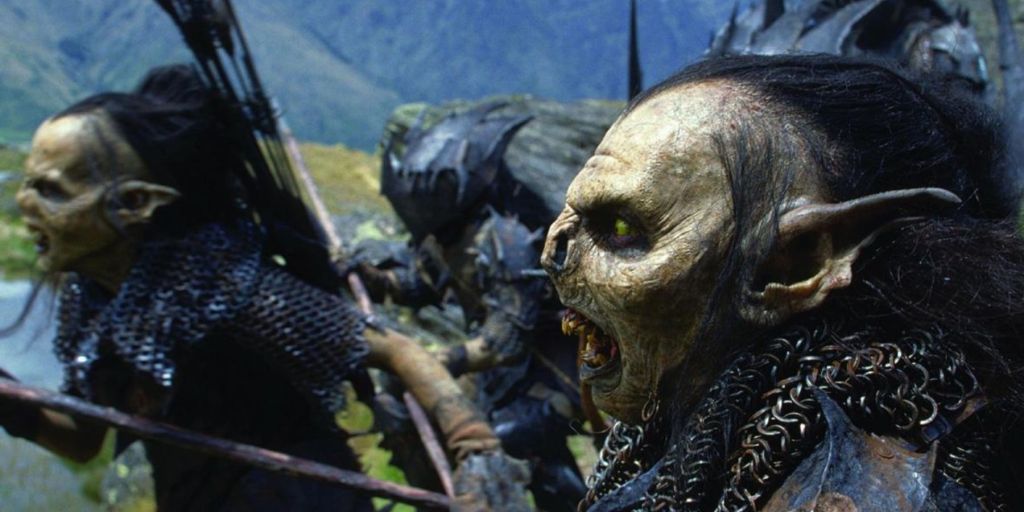
Well, I suppose in this case it feels especially extreme given the dichotomy of how much we learn about the forest and water tribes and how little we get about the ash tribe, and also how the aspects of their character that are all mashed together under this plainly villainous banner are from real people, in the real world. Personally, I do cringe a bit at the design of orcs in the Lord of the Rings movies, and especially the video games. It does feel a bit like aestheticizing morality to say “the evil people are also the ugliest ones”, yknow?
Which has extremely obvious real-world implications. If you see a movie where someone who is bald and wears bones in their nose is a cannibal rapist, then when you see someone like that in real life you will, to put it as mildly as possible, think poorly of them. Or, since such people are not generally wandering around American citites, you will think badly of the specter of them. The idea of them, and people like them entering your community. This movie is a slander on the whole continent of Africa, essentially.
Anyway, this is really just an add-on to the narrative problem this presents: the villains are boring, and in a specific way that villains are often boring in modern movies. They’re rendered completely flat, because there is some sort morality attached to complexity of characterization. If you learn about someone you might sympathize with them, and then feel bad when they are killed. If you are making a movie that costs $400 million, you don’t want the audience to have complicated feelings, you want them to feel good!
So, you get flat villains. They’re just sadists we learn nothing about. We’ve moved beyond queer-coded villains to nothing-coded villains. The best we get are aesthetics, like in this movie, or a few spare lines of characterization right before the final confrontation.
It’s easy to understand why that compromise happens. As a writer, you don’t want people to get the wrong idea! If you write a villain that’s too compelling and sympathetic, people may walk away with the exact opposite moral lesson from what you intended. Besides, there are only so many hours in the day, we gotta be efficient! Jettison that pointless backstory for a minor character and get on with it.
But again, what makes it stand out here is that the Avatar series is all about that kind of fussy worldbuilding. We get detailed information about how alien whale hunting works in the last movie, but for this one we can’t spend five minutes talking about the ash people and their whole deal? C’mon, man.
This extends to the human villains as well, frankly. In this movie, we get the return of the Scoresby, the evil whaler guy, and he’s still a complete dud. A nothing character, a winking reference to Moby Dick without any of the passion or pathos or interesting characteristics. He’s not even obsessed with the whale that took his arm, his characterization is completely unchanged from the last movie, he’s just all about killing whales and taking their brain juice to sell to people back on Earth. That’s it! He’s solely focused on that, in a way that is treated as a joke in the movie. Even as apocalyptic violence is going on all around him, he’s like “hey we can still make some money, let’s go!”
The other main human villain is the general and seemingly leader of the human settlement on Pandora… Frances Ardmore, apparently. I had to go look that up, I’m not sure anyone says her name in the movie. She is a completely flat authority figure, might as well be a police chief out of an 80s action movie. Absolutely zero characterization beyond being a no-nonsense military leader.
Which leaves us with the primary villains: Quaritch and Varang. They’re by far the most compelling part of this movie, I’ll freely admit, but even they feel boxed out by all the Sully family drama going on. Instead of forging a path and exploring another part of the world, we’re stuck litigating the issues of the Pandoran whales and the water tribe’s aversion to guns and whether they should kill this annoying human kid who’s always hangin’ around.
Wasted Potential
The thing that makes it maddening to me is that there’s meat on those bones! The idea of a group of Na’vi feeling abandoned by this big world-wide psychic network and instead siding with the colonizers has historical precedent. The ones who are willing to pick up a gun and think that this fancy technology is cool, actually.
This sort of mirror version of our heroes is a real mainstay of the genre. It reminds me of the heretical Chaos Space Marines in Warhammer 40k. People who have the same capabilities as the good guys, but who have made a conscious decision to do the “evil” thing. Who have such a radically different view of the world that it challenges the truth of the very narrative being told.
Like, in this case, what is the reason given for Eywa abandoning the ash people when their tribe was on the brink of destruction? Oh, there isn’t one. That argument doesn’t even happen! Varang never has a conversation with anyone in any other tribe about Eywa. She tells that story to Quaritch, who doesn’t care and is just trying to recruit her to his cause so she can help track down his nemesis, Jake Sully.
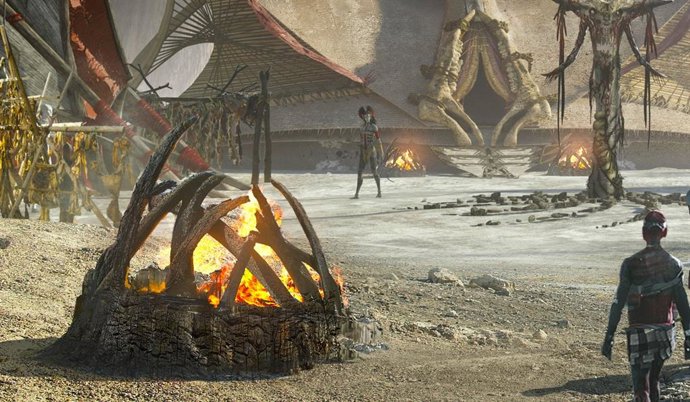
Side note: the reason the Varang are so good at tracking people down is that they are sadistic torturers, who know the way to get information from Na’vi in a way that humans don’t. So this is also a “torture is bad because it works” movie, on top of everything else!
The idea of people being pushed to the brink and joining up with their enemies becuase they have no other choice is compelling! We don’t see it in this movie. The Mangkwan are seemingly totally fine, living in the ashy wastes, raiding the other tribes. We don’t see any families or children or even them cooking food.
Fundamentally, the problem with the Mangkwan is that they’re not treated as people in the same way that all the other blue cat aliens are. The premise of this franchise is that the Na’vi, as a proxy for indigenous people of the real world, should be treated with respect and the crimes against them are horrible. But this movie gives that an asterisk: except this one tribe that is evil to its core. The bad indians, the one that use guns and slaughter their fellows and settlers alike with sadistic glee, well them it’s okay to kill.
Cameron constructed his perfect victims and now he has built his perfect perpetrators: completely empty and soulless, perfectly ugly and alien.
The Theatrical Experience
So where does that leave us?
This movie is going to be successful. It already is successful. It’s gonna make like two billion dollars, if not more. It’s a crowd-pleaser, if not as much as the last one. People will overlook any flaws for the sheer spectacle and aritstry of the 3D and CGI and whatnot. And as I said: that is an incredible achievement, and something you really don’t see as much today as in the past. A lot of modern movies skimp on that, in the Marvel model you tinker with it endlessly and then just kinda settle on something that looks okay at best.
I saw it at the Boeing IMAX theater at the Pacific Science Center in Seattle. The screen filled my whole field of view, and the 3D effect was absolutely perfect. But also, I was incredibly distracted by how wildly racist the portrayal of the ash tribe was.
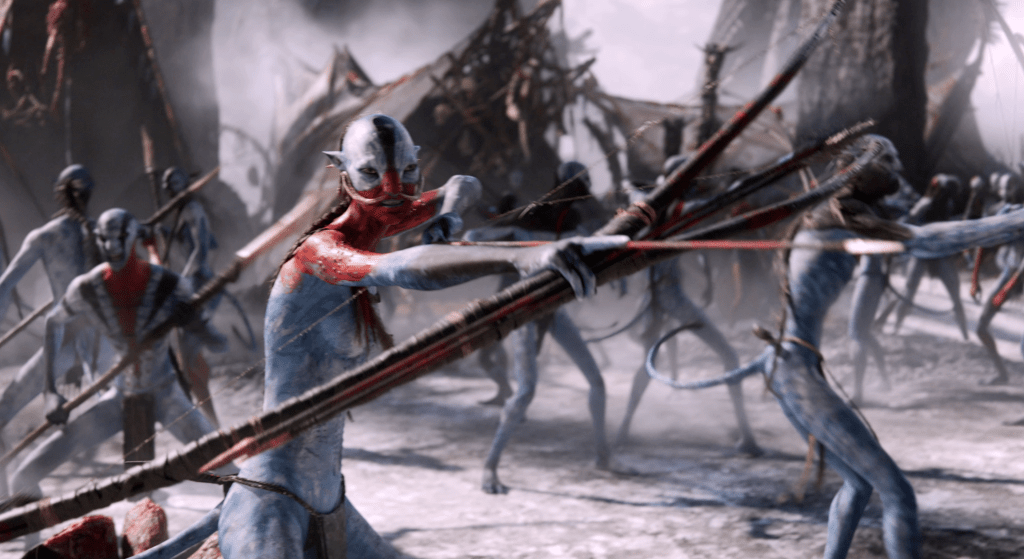
It made me feel like I was going insane. War whoops and scalping? Scarification and bones in noses? We’re really doing this, in the year of our lord two thousand and twenty-five? Don’t you feel any shame? Don’t we have a sense of common fucking decency anymore?
Like, for fuck’s sake, this is racism 101 stuff. You can’t just make your villains extremely exaggerated plains tribes who enthusiastically embrace the evil technology of the invaders and just play that totally straight. This movie could’ve been made in the 1930s with politics like that!
I often feel this way about takes I see online, and it contributes to my poor mental health to see society move in the direction that it has in the last couple years. In one of my favorite movies of this year, One Battle After Another, the protagonist is angrily ranting on the phone and says “are you retarded?” and I felt a chill up my spine. I actually cringed there in my seat, and gritted my teeth.
This shit does matter. And I’m tired of pretending that it’s all in good fun and doesn’t really mean anything, ever.
It’s just elemental! We’re just tapping into these age-old stories and truths, fundamental to all culture everywhere. No, there’s no reason to be such a spoil-sport tryhard who pays attention to the things in the slopt they’re shoveling down their gullet. We’re just regurgitating the same old cultural ideas in this massively popular movie, it could never have real consequences!

 The Beige Moth