
It’s been a while, but I’ve really been mulling this one over.

This is a review, specifically of the version of Suikoden included in the package called Suikoden I&II HD Remaster Gate Rune and Dunan Unification Wars, available on all modern platforms for fifty big ones. I may review the other half, Suikoden 2, at some point, but I kinda stalled out in it. That one doesn’t have as much juice for me, though it is generally superior in every way. And that’s honestly part of what I wanted to talk about, so perhaps this will serve as a reflection on both.
The Game Itself
Well, first off let’s just talk about the game itself, as a game.
Suikoden is a bit of an odd duck, in many ways. It’s a loose adaptation of Water Margin, one of the great classics of Chinese literature (more on that later), but in a sort of pseudo-Tolkien fantasy world. But one where the culture is still basically Chinese? It’s an interesting mix of influences, and is a bit irreverent as RPGs often were at the time.

In gameplay terms, it’s quite primitive and hostile towards the player, even for the time. As far as I’m aware, this is the first straight-up turn-based RPG that Konami had made, and it shows. Feels like it’s reinventing the wheel, still figuring out a lot of basic ideas that other studios had locked down ages ago. The biggest pain point is the dreaded inventory management. Each of the six characters in your party has their own inventory with limited spaces, and the equipment they are wearing also takes up spots.
This is one of those things that a lot of RPG series start off trying to do, making you move stuff around between people, because it’s realistic in a very basic way. You’ve got all this stuff, but who’s carrying it? Isn’t it an interesting proposition to have to array your items smartly before going into combat so the proper person is able to use them?
And the answer to that is “no, it’s not, it sucks, actually” (notable, this is different in the second game, you have a shared bag and that’s it). If it’s done very smartly, it can be an interesting wrinkle to add to gameplay, but this is not that kind of game. You are constantly swapping out party members, and their roles in combat are changing based on circumstance. And, frankly, the game is not difficult or complicated enough to warrant all this inventory management. Combat is generally pretty easy, with only a handful of fights in the whole game that require some careful planning ahead of time.
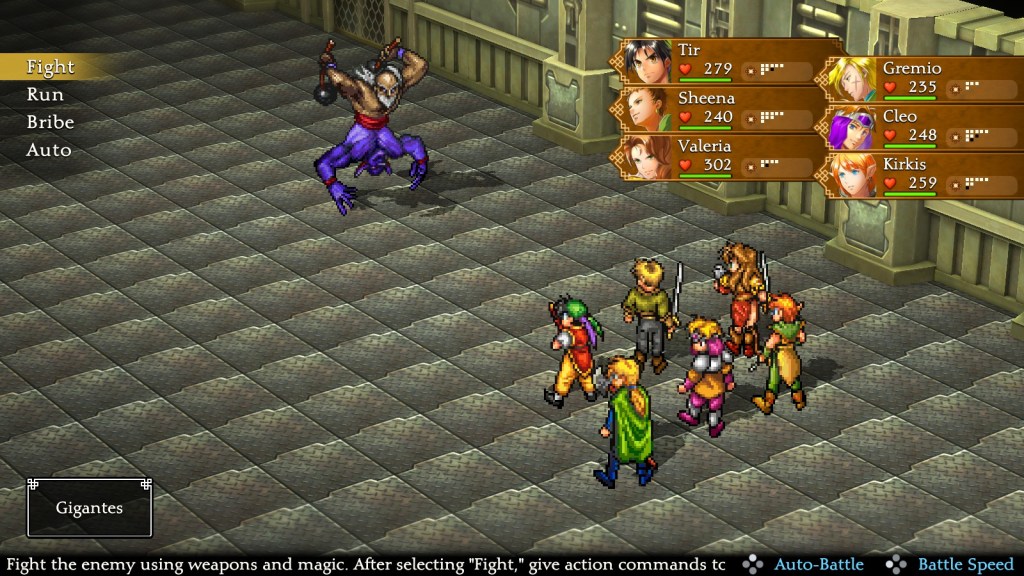
The central conceit, of recruiting tons of character to join your group, works pretty well. There’s a fun element to tracking down all the people, and fulfilling their conditions for joining in some cases. There are a few mean gotchas, but that’s why it’s best to play with a guide to make sure you get everyone. Playing an old RPG like this is often like putting on a stage play, you perform the necessary actions to get the best results. You can mix things up in certain ways, but the plot is the plot and there are some things that must always be done.
The other central tension or problem is a simple one: the game absolutely drowns you in playable characters, but for no real purpose. Often you are forced to take on a subset of the same core group for reasons related to the plot, even up to the final boss fight. Many of the characters you recruit are cookie-cutter, with one central gimmick or idea that often makes them basically useless for combat. They were just kinda throwing people in there, because there had to be 108 of them to make the literary reference work.
The graphics are generally pretty good, though the environments look a bit weird sometimes. I really appreciate that they left all of the sprites in place, the characters and the enemies in battle. Also greatly appreciated is the ability to move diagonally, which was actually added for an earlier PSP rerelease. It’s a small thing, but ends up saving a ton of time and frustration all throughout the game.
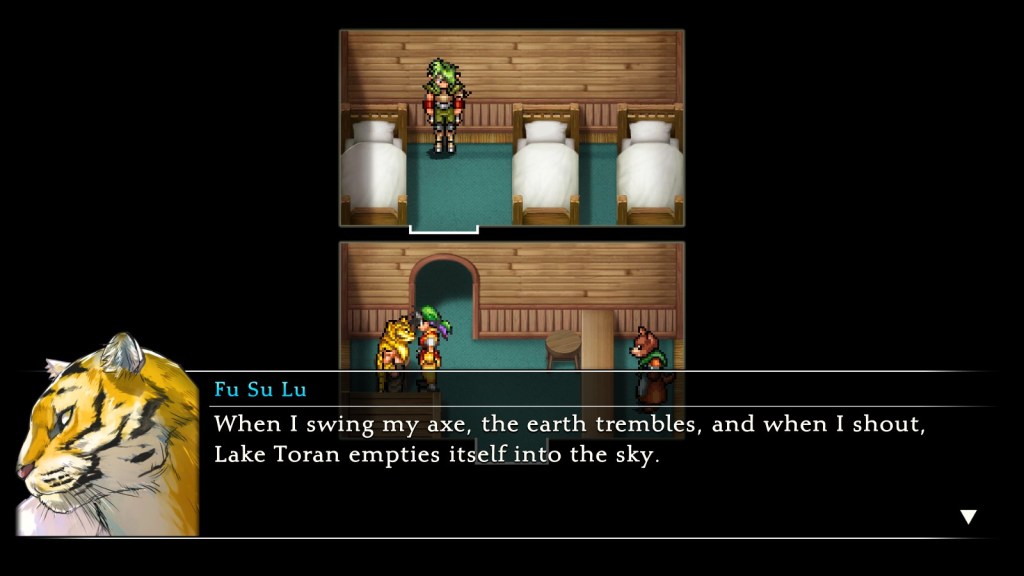
It’s not authentic at all, but it’s the best way to play the game, which is like a solid C+ RPG from the 90s. If you can give it some grace for its shortcomings, you’ll have a good time. Also: it is relatively short! I finished with all 108 recruits at a mere 20 hours.
The Old Wound
Now, for my own feelings: I fuckin’ loved this remaster. It’s everything I wanted, and I had an amazing time playing through it. I felt amazing when I finished it. But when it came time to reflect on the experience, in spite of how, well, crappy the game is in places, I had to think about why that was. What was it about this game that hit so hard for me?
Well, it’s 90s nostalgia, obviously. I’m a huge sucker for that, as someone born in 1989 I am perfectly in line to fall for it every time. But it doesn’t always work on me, of course. There’s a lot of stuff from the 90s that I didn’t like at the time and still don’t like now. Heck, many games being remastered, like the Spyro series, don’t really hold any appeal.
But this specific game is one that’s important to me, as basically the first RPG that I played entirely on my own. And I didn’t finish it.

Here is where you must indulge me in a brief bit of biographical detail. I have a brother who is six years older than me, so he was basically better than me at everything when we were growing up. That is not quite old enough for us to be separated and have more of a distant parent-child relationship, but not close enough that I could ever hope beat him in either a footrace or a game of Mario Kart.
I also had a slightly older next-door neighbor who loved JRPGs. He got way into them, and always finished them. He had a Playstation long before I did, and I would go over to his house and play those games (weirdly, after he was our neighbor, but never mind that) and just watch him beat them. This is how I am intimately familiar with the ins and outs of such classics as Final Fantasy VII or Chrono Cross without ever having played much of them myself.
So, I was constantly in a position of being a tagalong kid. Just there to watch and be amazed at the accomplishments of others, without doing much by myself. Me and my brother would tag-team games on the Super Nintendo, passing the controller when one of us died. I would have my turn and die in two minutes, and then he would go and finish multiple levels in a row. There was a great dramatic struggle going on, and it was him against the game, with me rooting for him, primarily.
I didn’t have the time to sit down and really understand these games. Didn’t have the time to practice and get good, and never felt the confidence to do so because I had someone doing so much better right in front of me, so I knew I wasn’t good, and would never catch up, and besides it didn’t matter because he could just do it already, and that was good enough.
And then when I was ten years old, I got my own game console for the first time, a Playstation 1. My dad got it for me as a gift for “graduating” from elementary school, I still remember him showing it to me in the trunk. I wanted some new Final Fantasy game, but it wasn’t in stock at the store, so he got me a game the clerk suggested: Suikoden.
The Reconquista Factor
So, this was the first time a game was only for me. Nobody else ever touched this one, it was all mine to play and struggle against. My first time I was old enough to take it seriously and try to actually finish the damn thing.
At the time, it didn’t really feel momentous, though it was exciting, of course. I had a great time playing it, and several part of it really stuck with me. The way the hero becomes an outlaw from his home and has to flee, the tragic sacrifice of his best friends, the elation of building a new home in a former hostile dungeon, and so on. I was on a rollercoaster of a fairly by-the-numbers plot and having the time of my life.
But eventually I tapped out. There’s a part very late in the game where you must finish a dungeon, fight a tough boss, then escape the dungeon and fight another boss to get out. I tried several times and couldn’t do it, then got some other game and got distracted, never went back and finished it.

But now! As an adult, I can go back and conquer that with defeated me in the past, using the vast powers now at my disposal. And that was all well and good, and it was great seeing those same moments again and realizing how deeply they affected me. How much of my love for body horror comes from the description of how the plant spores ate Gremio alive? Who could say.
So yes, perhaps this explains my highly specific notalgic love for some games and not others: I can finally go back and win! I can go and gain confidence from doing what I could not as a child. Unlike many other things, playing a game is an activity that is largely equal between adults and children, at least in the basic mechanics of it.
But I think there’s something else to it too….
The Old Pain is the Safe Pain
It sucks when something is unexpectedly bad. When there’s a bad ending, or a suddenly poor turn in storytelling that doesn’t work for you. It is what leads to complaints about a movie or TV show or game not being something it was never trying to be. When your expectations are dashed, it can be a profoundly negative experience.
This is why there is so much comfort in nostalgia. In exploring old things that are known factors, inside and out. To go back and experience anew something that you’ve seen in bits and pieces before is completely safe, you know there are no nasty surprises waiting for you. It can be captured and contained and examined from every angle. It has been left in the peaceful dust by history.
It’s fun to go back on a lark, but also: I know how this story ends. I don’t have to risk anything, I don’t have to put myself out there, I don’t have to try something and maybe get my heart broken. It’s the closest thing to being a spectator: being a tourist of the past.

This, I believe, is why I find it so hard to engage with brand new things, in my life. It’s much easier to pick up some dusty old paperback than it is to go out and buy some new piece of contemporary fiction, even in a genre I like.
Now, some of that is aesthetic, of course, but that too is shaped by this instinct towards the familiar and comfortable. If I judge based on the cover, if I dismiss out of hand, that too lowers the risk of having to endure the pain of finding I have invested a lot of energy into something that simply isn’t very good.
There are no social consequences to abandoning a playthrough of an old game that nobody else is playing. There is no expectation to see it through to the end, except the ones I place on myself. Any investment will be light and easily swept away by some new toy that comes along. It’s safe in every way.
Taste and Freedom
All that said… it’s more complicated than that. Let’s dig deeper.
Why am I playing games? Why am I reading books or watching movies or TV shows? Is it to edify myself and become a well-rounded human being? Is it because of social expectations? Is it to numb myself to the pain of the current political moment and the literal aches and pains of my body? Is it to seek inspiration for my own creative endeavours?
Well, it’s all of those things, at the same time, in different combinations at different moments. Sometimes I want comfort food of a particular flavor, like when I was sick and watched the first two seasons of House MD earlier this year. Sometimes I want to strike out and try something new out of a desire to connect socially and engage with an intellectually thorny work, like when I read Umineko a couple years back.
Media itself is extremely complicated and multifaceted, and the way that human beings interact with it is even moreso. It is not fair to simply break something down to “old things are bad, only read new things”. That’s stupid, and wrong.

My desire to engage with the media of my youth is not simple nostalgia, wanting to relive the old days and escape the current moment. For me, it is also about being able to live the life I was denied back then. To stand on my own two feet and accomplish things that felt impossible to me, to step outside of my old paradigm and sieze a piece of the world for myself, assert my own views and opinions and tastes.
The mistake that I have made, though, is closing my heart too much to new things. I am too resistant to trying something new, on a lark, out of fear that I won’t enjoy it. The way that old things can be encapsulated ahead of time offers protection from that risk. There’s nothing wrong with indulging in it, but it’s better to temper it with a wider variety of experiences along the way.
A Few Notes on Water Margin
One last thing I wanted to touch on is the fascinating similarities and differences between Suikoden and its inspiration, Water Margin.
The main theme or vibe common to both is this: wouldn’t it be cool to go live in a castle away from society with your friends? To make a new society that could fix things out there in the world or just hang out and have fun?
The novel Water Margin has a very different setting and social universe than Suikoden. It’s set in historical China (centuries before it was written, natch) and concerns a band of outlaws living in a swamp who fight tyranny. But… it’s localized tyranny that they’re fighting on behalf of the emperor, not any sort of larger structural problem in society, perish the thought. Very different from Suikoden, where the hero ends up not only killing the emperor Barbarossa (after he turns into a three-headed golden dragon) but then implements a republican government in his place.
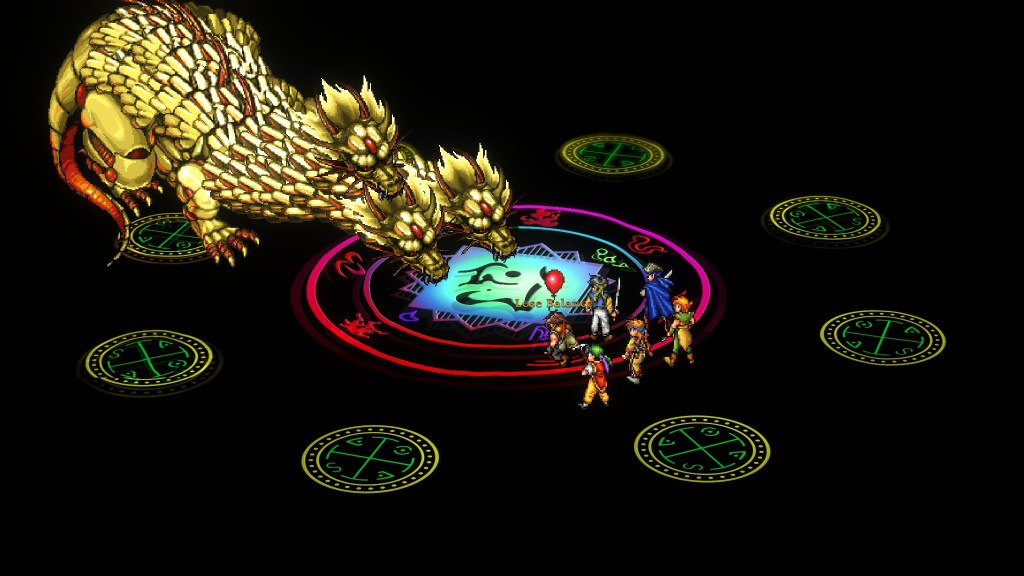
The things that are the same, however, are the focus on camaraderie and the drama of betrayal and revenge and whatnot. Suikoden is also not very concerned with the ins and outs of the overarching plot, that’s not really what matters as much as the melodramatic moment-to-moment beats of the storyline.
Water Margin is a book I have not read, but I’ve engaged with so many other pieces of media that were heavily influenced by it that I kinda want to now. Is it nostalgia to read a great novel from centuries before you were born? Am I hearkening back to the comfortable old tropes of 15th century China? Or would it be a form of due diligence, learning to more fully appreciate the vast tapestry of culture which we all partake in?
The problem with such a thing is that there’s no easy way in. There will be cultural allusions galore that I do no understand. Perhaps it would be best to attend to it with a guide, not unlike the ancient walkthroughs I consulted when I played Suikoden earlier this year….

 The Beige Moth
I really enjoyed your review and how you situated it in a broader conversation about nostalgia.
It definitely made me even more excited to play through the new remaster.
LikeLiked by 1 person
Check out this website for interesting insights on gaming philosophy and analysis: https://www.gameosophy.net/
LikeLike
This HD Remaster reminds me why I fell in love with Suikoden years ago. The mix of nostalgia and updated visuals is perfect! Check out 7Kabale for more info.
LikeLiked by 1 person
“Great write-up! I’m really excited for the Suikoden I & II HD Remaster because these two classics shaped so much of my childhood.
If anyone wants to compare the visual upgrades, Konami has actually shared the official feature breakdown here: https://www.konami.com/games/suikoden/hdremaster or hc1fund.com
The cleaner sprites and improved backgrounds really give the game a fresh feel without losing its original charm.”
LikeLike