
Alright, I’ve delayed enough, let’s finish this monster up.
I’ve had a real sense of impending doom lately, had some sleepless nights due to anxiety and whatnot. There are things I can do to combat that, and I know that I am in fact given to seeking out portents of disaster and using that as an excuse to take refuge in paralysis, but it would also help a lot if the country I live in wasn’t rapidly descending into fascism. Therapy is all well and good, but sometimes material conditions are the root concern, y’know. And yet, here I am, ready to finally finish out this years-long project. Let’s get to it!
Summary
Ahab has another monologue where he reflects on the state of his own mind, and best it relates to phenomena in the natural world. He laments that man cannot have revenge on the things that torment him the most, the immaterial winds both of the sea and of fate.
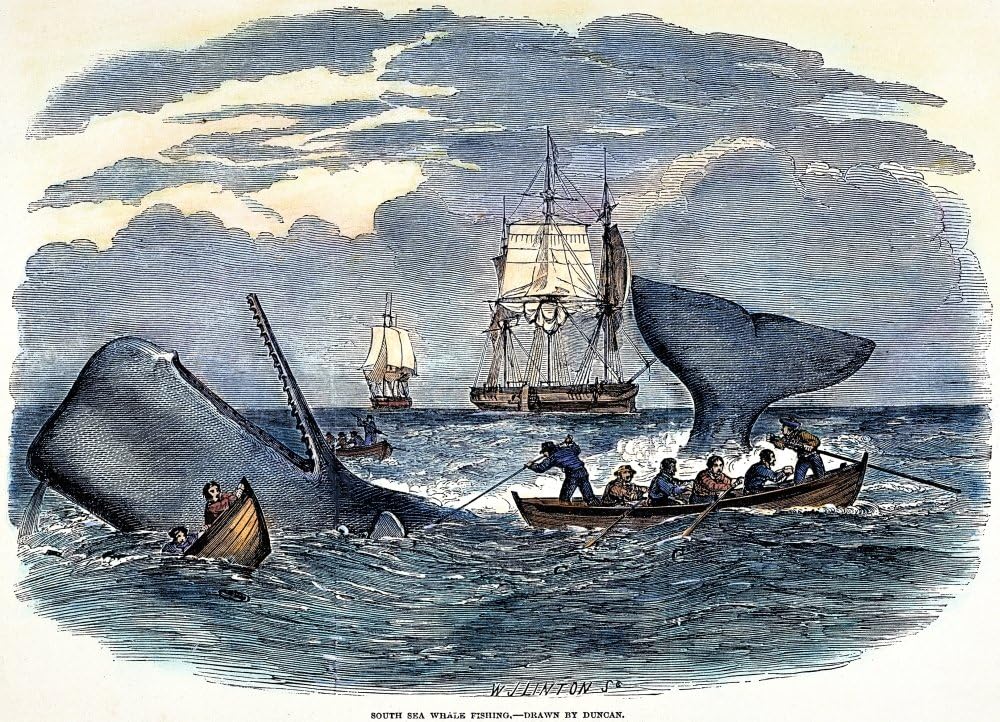
By noon, the Pequod still hasn’t spotted Moby Dick. Ahab orders the boat to turn around, reasoning they must have passed the whale in the night, since it was flagging from all the new lines and lances that were attached to it during the previous day’s battle. Ahab goes aloft once again, and soon spots the white whale heading directly towards the ship.
Launching into another monologue about how Fedallah’s prophecy may have been wrong after all, Ahab is lowered to the deck and prepares to make battle with his hated foe once again. He shares another symapthetic moment with Starbuck, shaking his hand before he leaves, while the latter implores him again to stop and let the whale go. But these pleas fall on deaf ears. The whale dives deep into the ocean as the boats are lowered.
Starbuck then delivers a monologue where he feels a sense of impending doom, feeling that the third day must be the final day, in one way or another. A seahawk rips the flag from the middle masthead of the Pequod.
Moby Dick emerges and is shrouded in mist, as he comes tearing towards the boats, smashing the sides of Stubb and Flask’s with his tail as he passes by them. While they are busy trying to stop them from capsizing, Ahab drops his harpoon in shock as he beholds the mangled corpse of his harpooneer, Fedallah, lashed to the whale by the trailing lines that were wrapped around him the previous day.
After shaking off his pursuers again, the whale seemingly takes a straight path away from the Pequod, out to see. Starbuck once again begs his captain to give up his revenge, one last time, yelling in despair from the deck of the ship. But Ahab, getting over his shock, orders his crew to continue pursuit. Seeing the crews of the other boats getting back on board the ship as he passes by, Ahab orders Tashtego to nail a replacement flag on the middle mainmast.
Tired from the trailing ropes and injured by lances, Moby Dick soon slows and turns about, stopping dead, floating in the water. Ahab approaches, and the massive whale seems completely unaware of his presence, so he quickly readies himself and launches his special, infernal harpoon at the flank of the leviathan.
That jolts the whale from his reverie, and he takes off once again, Ahab prepares to allow himself to be towed, but the line snaps instantly when pressure is put upon it. Moby Dick then turns around, capsizing Ahab’s boat in the process, and seemingly connects the attack not to the small boat floating nearby, but to the larger ship, which has continuously dogged him these last three days. Passing by Ahab, his tail strikes the side of the boat, but does not quite smash a hole in it.
Ahab is suddenly struck blind, unable to comprehend what he sees. When he regains his senses, he order his boat to chase the whale, but as soon as they begin rowing, a hole opens in the hull where the whale hit it earlier. The oarsmen busy themselves with baling water and trying to fix the leak.
On the Pequod, everyone freezes as they see Moby Dick charging towards them, gnashing his teach and roiling a great foaming wake as he goes. The three mates each make a final farewell in typical style: Starbuck laments his fate, Stubb makes a joke of it, and Flask has little to say but is mostly concerned with money. The ship attemptes to steer away from the whale, but he adjusts his course to continue his ramming approach.
Finally, he strikes the starboard bow, smashing an enormous hole into it, and the Pequod begins to fill with water. Ahab now recognizes the Pequod itself as the second hearse, the one made from American wood. He then gives his famous, final monologue, promising to hunt the whale to his last breath, and lamenting his wretched fate.
Ahab strikes the whale with one last harpoon, causing him to take off at speed once again. The line fouls, and after fixing it, Ahab is yanked overboard when it catches around his neck. None of the oarsmen notice, until the line runs out entirely knocks one of them out of the boat with its heavy eye-piece.
Then Ahab’s crew finally turn and see the Pequod rapidly descending beneath the water, now showing only the masts. The three harpooneers stay at their watch to the last moment. Tashtego is in the process of nailing a new flag to the mast when he goes beneath the water, and a seahawk tries to steal it once again, but is dragged down into the vortex caused by the sinking of the ship.
Every chip of wood and strand of rope is sucked down into the depths.
Analysis
Hoo boy, there’s a lot in this chapter. I think this is Melville at his most shakespearean, the soliloquys are coming hot and heavy here. Feels like a mashup of the last acts of Hamlet and Macbeth as everything falls into place, with a bit of King Lear thrown in for flavor.
Memento Mori
The main thing going on across all these monologues (or most them anyway) is contemplation of impending death. For some, the death is much more impending, while others still have room to doubt and bargain. Let’s take it one by one.
Ahab gets the most time devoted to his thoughts, of course. At first, he’s still trying to wrangle a way out of his prohpesied death, poking holes in Fedallah’s predictions, trying to see a way that this all might turn out okay. He looks to the natural world for comfort, seeing hope in the moss growing on the mast as he’s lowered to the deck.
“Befooled, befooled!”—drawing in a long lean breath—“Aye, Parsee! I see thee again.—Aye, and thou goest before; and this, this then is the hearse that thou didst promise. But I hold thee to the last letter of thy word. Where is the second hearse? […]”
It’s only when the full truth of the prophecy is laid bare before his eyes that he fully enters his fatalistic, suicidal mode. Even as his ship sinks before his very eyes, the very worst thing imaginable to a whaling captain, he decides he has to go through with his quest. At that point, why not? There’s no more hope, he’s out of last chances, so let’s just get on with it. Maybe he can still strike his blow against fate.
Starbuck is basically just in full lamentation mode this whole chapter. He’s still trying to convince Ahab, but kind of half-heartedly. There’s a glimmer of home when his captain agrees to shake his hand, but it comes to nothing. He thinks of how others will be affecte by his death, laments that he will never see his wife and child again, and all this when the whaleboats are being lowered!
In the last, the man of god becomes another prophet. He gets an inkling of his own death in the mere appearance of Moby Dick on that final day. When it comes to the ship’s final moments, he still tries his level best to save everyone, ordering the ship to evade the whale’s attack. But in his heart, he knows it’s already over, and he can only ask for the mercy of God.
Up helm again! He turns to meet us! Oh, his unappeasable brow drives on towards one, whose duty tells him he cannot depart. My God, stand by me now!
Stubb still sees this all as a big cosmic joke, he takes the whole thing in stride. Oh sure, he’s cursed by fate, but that’s all in good fun. Everyone’s cursed by fate, nobody’s getting out of this life alive, so we may as well have some fun while we can.
I grin at thee, thou grinning whale! Look ye, sun, moon, and stars! I call ye assassins of as good a fellow as ever spouted up his ghost. For all that, I would yet ring glasses with ye, would ye but hand the cup! Oh, oh! oh, oh! thou grinning whale, but there’ll be plenty of gulping soon! Why fly ye not, O Ahab! For me, off shoes and jacket to it; let Stubb die in his drawers!
And finally, Flask has little to say. Ever the practical man, at the last minute, he’s worried about what little money will be left behind for his mother, and is annoyed by Stubb’s boasting and hollering.
“Cherries? I only wish that we were where they grow. Oh, Stubb, I hope my poor mother’s drawn my part-pay ere this; if not, few coppers will now come to her, for the voyage is up.”
And that’s it! Ahab gets by far the most words to say in this chapter, it’s his mythic arc that’s coming to a close, while everyone else is merely dying.
Retribution, Swift Vengeance, and Eternal Malice
So, what of the whale in all this?
In my analyses thus far, I have made the case that there is nothing supernatural going on with Moby Dick himself, and he was simply acting as any whale might in this situation. In spite of all the human motivations ascribed to his actions, he was simply a big, angry whale, going about his business in the ocean.
How, then, do we square that with what happens in this chapter? When he maliciously destroys Ahab’s ship before his eyes, and then drags the captain to his eternal doom?
Well, it’s quite easy, in fact. Melville has been seeding this since the first day of the chase, when the Pequod charges at Moby Dick when it is swirling around Ahab. The ship has been ever-present in these fights, even as the individual ships are easily smashed and the crews scattered upon the waves, that is only temporary relief.
Think about it from Moby Dick’s perspective: first he sees some small things, and he plays with them a bit. But then he’s bullied and chased away by some big, mysterious thing. Then, he is actually attacked, pricked by harpoons, and finds himself lagging in the water. He swats away the annoyances that hurt him, but again spots that larger, mysterious thing floating very nearby.
Each time, the Pequod is much closer to the combat than is typical for a whaling ship. Indeed, Ishmael has told us that boats often pass over the horizon away from ships while they engage in combat. The ship is a refuge, the home base, but not actually part of the hunt itself in a meaningful way. Thus, the whales have no reason to fear them. Indeed, we saw that way back when Pequod encountered the whole pod of whales, and floated among the mothers and children without incident.
But Moby Dick finally figures it out: it’s the big thing that’s the problem. He keeps swatting away these annoying little things, but they keep reappearing and chasing him.
My favorite thing, though, is that Melville makes it clear with the same logic as a slamming door farce that Moby Dick assumes the Pequod is the source of the penultimate attack. After smashing the other boats, he swims away and then stops, while Ahab essentially sneaks up on him, and hits him with a harpoon.
At length as the craft was cast to one side, and ran ranging along with the White Whale’s flank, he seemed strangely oblivious of its advance—as the whale sometimes will—and Ahab was fairly within the smoky mountain mist, which, thrown off from the whale’s spout, […].
Literally close enough to be in the mist of the whale’s spouting, as he catches his breath. Moby Dick simply didn’t notice that he missed one of the boats in his thrashing advance, and assumes that the big ship has finally attacked him, and takes off for it, deciding to make combat with this weird… other whale, maybe?
bethinking it—it may be—a larger and nobler foe; of a sudden, he bore down upon its advancing prow, smiting his jaws amid fiery showers of foam.
That is definitely the implication here. Whales are creatures like any other, and male sperm whales are known to fight one another with their enormous heads. So, seeing this big threatening thing, Moby Dick decides to go and ram it, to get it to go away.
I do love how the whale is clearly exhausted and just wants to rest in this chapter. It keeps violently throwing off its pursuers and then just… stopping, floating in the water. It just wants to rest and heal up for a bit, after getting poked with so many more harpoons and picking up this annoying netting of ropes the previous day. He’s been pushing forward the best he can through the ocean, trying to get away, but his pursuers are relentless.
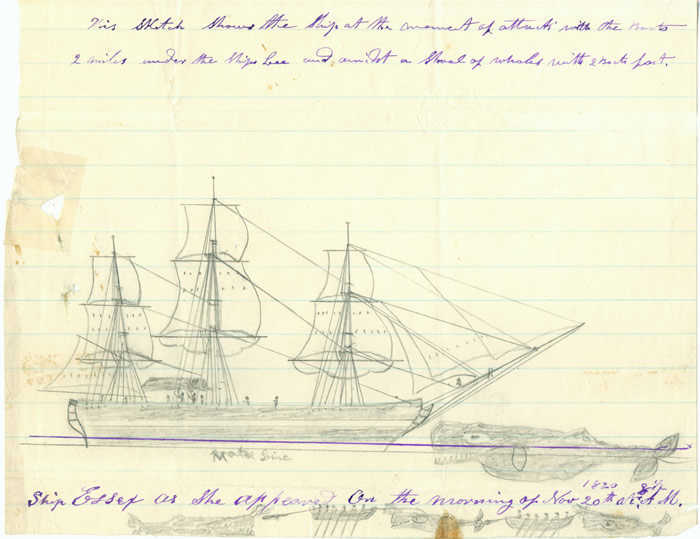
So, in the end, I really don’t find anything fantastical about this. Indeed, it was inspired by a real incident, the sinking of the Essex. Though the circumstances were different in that case, it did show that a sperm whale could, in fact, sink a ship by smashing it with its head. As Ishmael has told us time and again: whales are dangerous! They’re gigantic, and enormously strong! Death is common in the fishery, all those empty graves back in Nantucket were not just for show!
The Surreality of Disaster
Something I love about this chapter is how quickly it all happens, when Moby Dick finally smashes a hole in the bow of the Pequod.
There’s no hope of rescue or repair, everyone instantly knows that the ship is doomed. The oarsmen in Ahab’s boat don’t even know it happened, or that Ahab has been dragged to his own watery grave, until it’s far, far too late (more on that next week).
In fact, if there’s anything that feels supernatural in this chapter, it’s the vortex that forms as the Pequod sinks, drawing in every last bit of evidence that it ever existed. This is the part that feels like the wrath of god, or fate, or nature itself. The cruelty of the sea suddenly making itself known, to those who bravely plow its waters day after day.
It’s interesting how Ahab considers the natural world to be his ally after The Candles, even as every indication shows that it is his greatest enemy. The storm howls to push him away, the mild and enchanted days lull him into complacency and make him consider abandonment of his quest, the sea destroys his ship before his very eyes. He is insulted and murdered in the end, as Ishmael warned of so many chapters ago.
From Brit (chapter 58):
that however baby man may brag of his science and skill, and however much, in a flattering future, that science and skill may augment; yet for ever and for ever, to the crack of doom, the sea will insult and murder him, and pulverize the stateliest, stiffest frigate he can make;
And from this chapter, Ahab’s final monologue:
Oh! ye three unsurrendered spires of mine; thou uncracked keel; and only god-bullied hull; thou firm deck, and haughty helm, and Pole-pointed prow,—death-glorious ship! must ye then perish, and without me? Am I cut off from the last fond pride of meanest shipwrecked captains? Oh, lonely death on lonely life!
Knowing the ending in advance, Old Ishmael has warned us about it time and time again. And now we have it: the natural apocalypse. Every last bit of evidence of the ship’s existence: erased forever. Drawn into the depths of the ocean, the cruelest fate that can befall man. No grave to mark their death. the ocean smooths it all over and covers it up with silence and peace in the end.
Now small fowls flew screaming over the yet yawning gulf; a sullen white surf beat against its steep sides; then all collapsed, and the great shroud of the sea rolled on as it rolled five thousand years ago.

Well, I can’t think of a better way to end it than that! Obviously, there’s a lot more that could be discussed here, but those are my thoughts, and that’s what this blog is about, after all. Why, I could dig deeper on Ahab’s first monologue, and his desire to become insensible and disembodied; how his true wish is actually to become part of the inanimate natural world, so that he may no longer be tortured by his own mind and body.
But that’s for other scholars to pick over, as I’m sure they’ve done many times in the nearly two hundred years since this book was published.
Were we reading the original British edition, this would truly be the end. That version was heavily bowdlerized (perhaps by Thomas Bowdler himself!) and lacked the epilogue. Oddly, that version was also much better received by critics than the complete and unexpurgated edition later published in the United States.
But no, I am reading a full, unabridged copy, and so we shall return one last time next weekend to the Pacific Ocean, and see what fate befell our ostensible narrator after this disaster. Indeed, Ishmael himself went strangely unmentioned in this final chapter! It’s no wonder that British readers were quite confused.
Until next time, shipmates!

 The Beige Moth
Congratulations
I’ve been following the last 40-50 Chapters
Really enjoyed your analysis
I’m putting the link to Power Moby Dick last chapter here
So you can print out your certificate of completion
It’s a little thing to acknowledge your accomplishments
http://www.powermobydick.com/Moby136.html
LikeLiked by 1 person
I just finished rereading Moby Dick (my second read through), and I really enjoyed your commentary! I’m so glad you finished it before I began my reread, it was a lot of fun finishing up a few chapters and then coming here to see your take on things. Really great job!! Amazing book, of course!
LikeLiked by 1 person
I started tuning into to these blogs when things got confusing (yay old whaling jargon) to now just wanting to hear your thoughts. thanks for keeping me company in the Pequod! cheers x
LikeLiked by 1 person
Man, I cannot thank you enough for doing this project! I had no idea what I was getting into when I decided to start 2026 by reading this classic and I thought I wouldn’t be able to finish it till I found you. Your summaries and analyses have been a total life-saver and I’m sure this blog will help a ton of people in the process of not just getting through but actually liking this book (which with your help I have liked quite a bit more than I expected).
Truly truly, thank you 💛
LikeLiked by 1 person