
Well, I’ve had quite a week, as have many of my fellow Americans, I would reckon.

There was about 24 hours where my heart was seized with despair and rage in a way that I have never experienced before, or at least not in a very long time. But I was able to channel that in some productive ways and otherwise burn it off, feeling resigned and determined now. The less said about events on the national political stage, the better.
Summary
Ahab leaves his cabin, and shoos Pip back inside, saying he’ll be back soon.
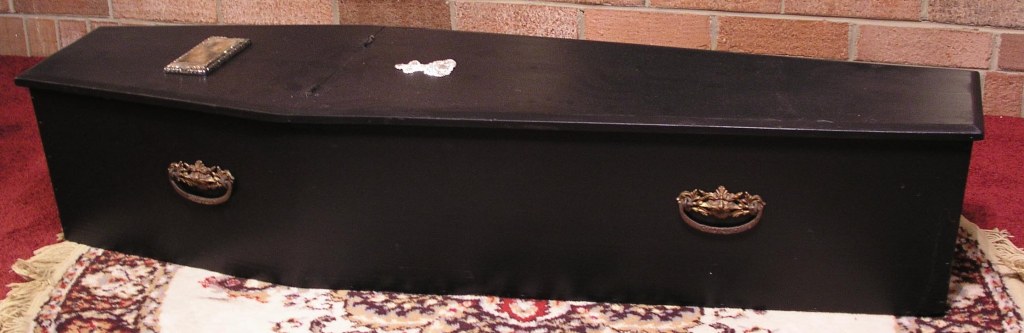
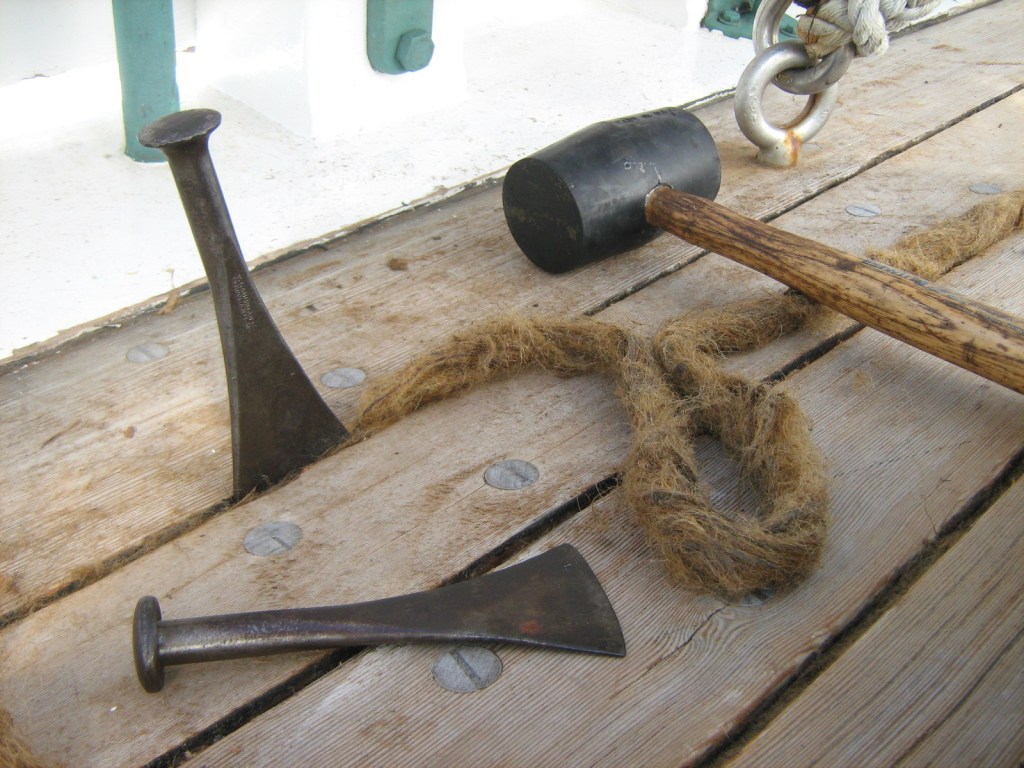
He runs into the carpenter, working on caulking the coffin for the new life-buoy, at the end of the gangway. Responding with anger, Ahab tells him to clear it out, and asks what he’s working on anyway. After some confused and cryptic back and forth, Ahab storms off and tells the carpenter to finish up before he leaves his cabin again.
Returning to his sanctuary, Ahab wonders at the philosophical wisdom of his new roommate.
Analysis
Ah, this is a fun chapter. Continuing on with our recent theme of relatively normal people interacting with Ahab and being… puzzled.
A Leaky Cask
It shows that Ahab is truly becoming more and more unstable as the voyage goes on, especially in light of recent events. He’s just barely holding it together, and his new conviction has only made it harder for him to keep up his act of sanity around the crew.
Ahab sees himself as a man walking around a world of myth. He finds allusions to the classical tales of gods and titans left and right as he goes about his business, in a literally comical manner.
“Art not thou the leg-maker? Look, did not this stump come from thy shop?”
“I believe it did, sir; does the ferrule stand, sir?”
“Well enough. But art thou not also the undertaker?”
“Aye, sir; I patched up this thing here as a coffin for Queequeg; but they’ve set me now to turning it into something else.”
“Then tell me; art thou not an arrant, all-grasping, intermeddling, monopolising, heathenish old scamp, to be one day making legs, and the next day coffins to clap them in, and yet again life-buoys out of those same coffins? Thou art as unprincipled as the gods, and as much of a jack-of-all-trades.”
“But I do not mean anything, sir. I do as I do.”
“The gods again. Hark ye, dost thou not ever sing working about a coffin? The Titans, they say, hummed snatches when chipping out the craters for volcanoes; and the grave-digger in the play sings, spade in hand. Dost thou never?”
Thus we find that the mythologizing that Old Ishmael has been engaging in is being projected back onto Ahab. A man split between fantasy and reality, never quite sure where he stands. Constantly leaping at shadows, wondering if they will be his deliverance or doom.
In a metafictional way, you could say that Ahab is overly concerned with the narrative of his own life. He’s obsessed with the notion of these grand powers of fate that made and mold the world, that he sees as his hated enemies, so he’s losing touch with the actual reality going on around him. Which is neatly personified here as a befuddled carpenter, just trying to do his damn job!
Narrative vs Reality
Come to think of it, this was something of a theme I picked up on very early in this book, a sort of tension between the ideal of neat narrativization and the messiness of reality. This is touched on again wtih the talk of the incomprehensible nature of true reality some chapters back, and now we have it again, in a very fun way, for a change.
Humans love narrative. We love to organize things into stories, so we can communicate them to others, and so we can process and understand them. By assigning meaning to things, assigning a purpose, we can have greater control over them.
This is what Old Ishmael is doing by writing this book, and this is also what Ahab is doing by writing his own legend as he lives it. This is why he needs those Shakespearean prophecies from Fedallah, the same way that Ishmael needed the prophecy of doom from Ezekiel back in New Bedford!
Because this is a way of freeing yourself from guilt, or from the crushing weight of responsibility for your actions. From the fear that things could have been different, from regret and pain over your actions.
If it was all predestined, if this was the will of something greater than myself, if this is all some big story that has to go this way, then it’s not my fault!
There’s also a very funny thing here, which is that Ahab is simply doing literary analysis on the things happening in the ship. He sees a coffin being made into a life-buoy and is like: that’s a little on the nose, isn’t it? What is the symbolism of this supposed to be?
He’s not just taking the broad strokes, he’s actually looking at stuff going on in his life and trying to interpret it, as though it were written in a novel!
The Wellspring of Philosophy
So, what’s up with Ahab and Pip, anyway? The whole thing does seem a bit… odd.
Pip, as we know, what driven mad by exposure to the open ocean for several hours, after being abandoned because he leapt from the whaling boat one too many times. He also interprets the world around him in a very dreamlike way, detached from his own perspective, yet in a way where he is an infinitely pathetic victim, rather than a conquering hero.
But, perhaps there’s not too much daylight between the two, after all. Ahab justifies his actions with his heroic quest to spit in the face of whatever forces of fate caused him to be mutilated by a whale. What is that if not an argument from victimhood?
Anyway, this is all to say that it seems that the two are on the same wavelength, and have been having a lot of fun talking about various mysterious things together. As unfortunate as this line is:
Now, then, Pip, we’ll talk this over; I do suck most wondrous philosophies from thee! Some unknown conduits from the unknown worlds must empty into thee!
It doesn’t seem like there is anything untoward going on between the two. It’s more that those two, the old white man and the young black boy, are thematic opposites, united in their shared trauma and reaction to it.
Ahh, nice to get back to this, after such a stressful week.
I’ve been thinking about a lot of different things, but it’s always helpful to focus through the lens of a piece of fiction I’m very familiar with.
Until next time, shipmates!

 The Beige Moth
is Pip a pathetic victim or the ultimate transcedent soul? Is Ahab a would/be conquering hero or an arrogant fool with a diseased ego. Oh, how Melville penetrates right down to the bottom of the American soul?
LikeLike
is Pip a pathetic victim or the ultimate transcedent soul? Is Ahab a would/be conquering hero or an arrogant fool with a diseased ego. Oh, how Melville penetrates right down to the bottom of the American soul?
LikeLiked by 1 person