
I almost forgot!
This week I read the chapter early, because I was bored at work, and thought about writing the post really early. Then, I almost forgot to come and write it this evening because I was too caught playing Unicorn Overlord (which is really good by the way). But no! I will continue posting, and I will see this through to the end.
Summary
As part of their normal routine, the crew of the Pequod were pumping out the hold one day, when they discovered that one of the precious casks of sperm had sprung a leak.
Starbuck breaks the news to Ahab in his cabin, who doesn’t care and tells him to go away, and that they are not going to stop and open the hold to find the leak, but continue on their current course. Starbuck boldly questions Ahab’s decision, almost to the point of defying him, appealing to the interests of the owners back in Nantucket. Ahab thunders against him and says that he alone is the master of that ship while it is at sea, so he gets to decide, and again demands that Starbuck leave the cabin.
After having his orders questioned again, Ahab grabs a musket from the wall and whips around to point it at Starbuck. Finally cowed, Starbuck slinks out of the cabin, muttering that Ahab should be most afraid of himself. Cooling down, Ahab reassesses the situation and ends up calling for the hold to be opene, and the leaking cask found and fixed.
Analysis
Whew! Pretty dramatic chapter this time, a nice follow-up to our little philosophical reverie last time around. It certainly feels like a logical continuation though, since Ahab is initially in a similar frame of mind, though he eventually shakes himself out of it a bit.
Where Are We?
When Starbuck goes to see Ahab, it’s mentioned that he’s laboring once more over his charts, and we get our first indication in a while of where the ship is actually located. Last we checked in, I believe they were passing through the Molucca straight, narrowly avoiding some pirates and then getting caught up in a great herd of whales. Since then it’s just been nebulously… on the ocean. Which, y’know, fair enough!
But now we know they’re near Formosa (the old name for Taiwan) and what Ishmael calls the Bashee Isles, also known as the Batanes, which are between Formosa and Luzon, the largest island in the Philippines. They’re roughly Northeast of Formosa, so actually coming close to Okinawa and the Ryukyuan islands, which they will follow in the direction of Japan.
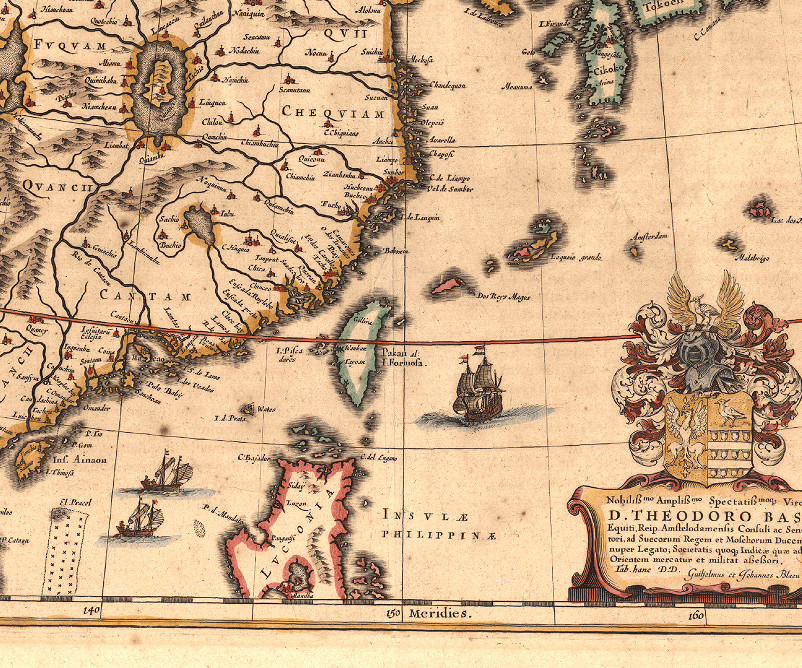
We get the delightfully old timey names of the Japanese islands: Niphon, Matsmai, and Sikoke. As far as I can tell, only one of these is even close to the actual name of one of the major islands of Japan, “Sikoke” being a pretty reasonable transliteration of Shikoku, especially given that it was still illegal for any foreigners to visit Japan at the time (except for the one trading post the Dutch operated, of course).
As we’ve learned before, one of the best whaling grounds is off the coast of Japan, so it makes a lot of sense that they’re heading in that direction.
Status Quo
This chapter is the beginning of things finally coming to a head between Starbuck and Ahab. We still have about 25 chapters left of this book, but I’ve been reading a physical copy lately, and I can tell ya that there is not much left in terms of raw page count. It’s time to start getting to it!
To this point, the ship has operated pretty smoothly. Things are going pretty normally, except for that one time Ahab was rude to another whaling captain, and… oh yes, his secret personal harpooneer and boat crew, that was pretty unusual. But for everyone essentially agreeing to follow his mad quest for revenge, it’s been pretty much business as usual, hunting whales, harvesting their oil, etc.
This is the first time that Ahab truly makes a decision that is at odds with Starbuck, and with the interests of the owners of the Pequod. Sure, he was yelling about going after some whale, but as long as it doesn’t get in the way of business, profaning God and nature isn’t really that much of a dealbreaker to Starbuck, it turns out.
Well, okay, to be fair to the old (not true, he’s actually quite young) Quaker, Ahab has not yet actually had an opportunity to damn all their souls to hell through his madness, becaus he hasn’t found his quarry yet. So, we’ve just had a tense status quo. As long as nothing disrupts the usual operation of the whaling boat, Starbuck can pretend everything is fine. Maybe Ahab will come to his senses and not go through with it in the end, who knows!
In this scene, Starbuck is so painfully reluctant to actually question his captain, we fall back into a bunch of 19th century style hedging and inexplicable verbiage to mask his intentions:
“Nay, sir, not yet; I do entreat. And I do dare, sir—to be forbearing! Shall we not understand each other better than hitherto, Captain Ahab?”
This is essentially him say “what is going on, can we talk?” but Ahab takes it as the gravest possible insult. He knows that even the smallest hint of mutiny could destroy his whole plan, so he is quick to overpower his first mate with the threat of violence. But mostly, he just wants Starbuck, and this problem, to go away and stop distracting him.
Standing on a Powder Keg
Both Starbuck and Ahab have to be very, very careful in this situation.
Being on a ship, the threat of mutiny is ever-present. We had an extended examination of it earlier in the book, and the thing is: that could happen on any ship, at basically any time, if the balance of emotions is tilted too far in one direction or another.

Ahab must be careful to appear powerful, rational, and still workin in everyone’s best interests. Remember: this whaling voyage is essentially a joint venture between the owners of the Pequod and every single crewman, individually. They are not being paid wages, they are taking a share of the profits (a very small share in poor Ishmael’s case). So if they go home empty-handed, every single person on board suffers.
And not in, like, an abstract way. Oh no! Pain in the pocketbook! No, some of these men may well starve on the streets, or have their families starve, or be forced to seek passage on another five year voyage immediately. There are real, material consequences to that leak in the hold, and everyone is aware of it!
This is why, in the end, Ahab does order them to stop the ship and open up the hold. Or, rather, “up Burtons”, whatever that means (another one of those mysterious whaling terms where every search just leads back to… this book). He doesn’t want to give the game away, and he wants to maintain the veneer of normalcy that has reigned thus far.
Similarly, Starbuck is in the position of not wanting to look like a mutinous villain to the crew. We know that everyone is basically on Ahab’s side when it comes to the matter of hunting Moby Dick for vengeance. They all yelled in approval, they are all gazing longingly at that doubloon nailed to the mast, and they feel for their captain.
The primary danger to whalers is whales! Of course they would be sympathetic to a maimed captain, seeking some manner of peace through killing. Also, hey, large, adult, male sperm whales like Moby Dick are, in fact, what they’re after anyway, so whatever. It’s all part of the job.
If Starbuck tries to inspire a mutiny and misses the mark, he is in just as much danger. He could be the one labeled a mutineer, abandoned on some island or in a small boat on the vast ocean.
Thus, it is not a mere battle of wills between two men. Ahab could easily shoot Starbuck with the musket, and Starbuck could do the same while Ahab is distracted. But it’s not so simple. There are other people around, with their own desires and opinions on things.
Absolute Authority
Ahab wishes to have complete control over his own ship. And, indeed, he has largely enjoyed that control since the voyage began. As soon as they were away from the port, the owners truly had no say in what happens on their ship.
“Let the owners stand on Nantucket beach and outyell the Typhoons. What cares Ahab? Owners, owners? Thou art always prating to me, Starbuck, about those miserly owners, as if the owners were my conscience. But look ye, the only real owner of anything is its commander; and hark ye, my conscience is in this ship’s keel.—On deck!”
Possession is 9/10ths of the law, as they say, and Ahab possesses his ship and crew, body and soul. AS long as his spell rests upon them, he is safe, and has nothing to worry about.
Once again, I am reminded of modern archetypes and modes of thought. It is a kind of rugged individualism, the denial of community and friendship, in favor of absolute control and dominion. Everyone is free, and by everyone I mean “me”. Other people only exist to be my slaves and do my bidding.

Tying into ideas from the last chapter, Ahab doesn’t want his crew to worry, he doesn’t want them to think at all, he’ll do all the thinking for them. They’re only needed to row boats and throw harpoons, so he can have his grand accomplishment at the end of this long voyage.
It’s a kind of obsession with honor and community as a game, rather than as real connections between human beings. They want control, they want to be owed debt, but never to pay it themselves. The logic of capitalism is only supposed to work one way: Ahab will offer the golden doubloon as a reward for whoever helps him accomplish his bloody objective, but he will ignore the vastly more valuable sperm leaking out of the hold as a distraction.
It grounds the great man theory in its most basic reality: we must as prostrate ourselves, starve and kill ourselves, so this other dude can win a trophy. So he can make a point, and win a moral victory, over something that’s not even sapient.
Man, I love whenever this book gets back that theme, stripping away all the pretensions and showing what’s really going on. I think of it as a very leftist ideal, but as I’ve learned more about capital-t Theory and what a lot of more recent ideas have been… I suppose it’s not really true. Or, at least, it’s not simply true, though I still think of it as an ultimately leftist ideal.
That we could get past all of this nonsense theorizing, strike through all the pomp and circumstance, ignore the rhetorical flourishes, and examine what’s really going on. I suppose it’s an unattainable ideal, in the end, but one can still take stabs at it. Sometimes describing what’s happening to you is almost impossible, because nobody has ever told you how to talk about it.
Anyway, this was a good one. Glad I stayed on track and got it done. Things are only going to get more intense as we continue towards the end!
Until next time, shipmates!

 The Beige Moth