
Dang, I should’ve saved the Walrus and the Carpenter image for this week. Ah well!

Trying to get back into a groove here, not make that last post a one-off. Especially since this one follows up on it in an extremely direct way. Why, if it weren’t for the complete shift in tone and genre, they could’ve been combined into one chapter. Perhaps an author with a different bent might’ve done so, if somehow combining the ideas presented previously into the milieu of this scene in order to make a more harmonious whole. But Melville is not such an author, and neither is Ishmael. The medium is the message, it would do you well to remember.
Summary
This chapter is presented as an alternating dialogue, with some stage directions.
The carpenter described in the previous chapter begins constructing Ahab’s new leg, babbling to himself as he goes, as well as sneezing as the bone produces a great deal of dust as it is cut and shaped. Ahab approaches and the carpenter calls him over to measure his leg.
Ahab speaks in enigmatic jokes and confuses the carpenter, but it’s all laughed off. Then, he describes the way that he still feels sensations, especially pain, in his missing limb, demonstrating to the carpenter and having him bring his own live limb up on a bench next to Ahab’s missing one.
Departing, Ahab laments that he is reliant on such a simpleton in order to have a leg to stand on, and indeed that he must rely on other men at all, for anything. The carpenter, meanwhile, gets back to work and remarks that Ahab is quite a queer man, and he must have worn down his leg from using it too vigorously. He prepares to finish the leg, and admonishes the blacksmith to hurry up with his part of it.
Analysis
Hoo boy, there are some interesting dynamics going on in this chapter. Feels like it’s been ages since we had a scene with Ahab talking to someone… but also, I have not been writing on this blog regularly, so that is probably not the case. Ah yes, the gam with the Samuel Enderby was less than ten chapters ago!
Anyway, the shift in genre is interesting here. It’s not like the other chapters we’ve had that were written as stage directions, this one lacks identifying names for the speakers of each line, or indeed quotation marks at all. It’s simply trading back and forth by the paragraph, and the reader is left to puzzle out what’s going on, exactly. Like so:
Well, manmaker!
Just in time, sir. If the captain pleases, I will now mark the length. Let me measure, sir.
Measured for a leg! good. Well, it’s not the first time. About it! There; keep thy finger on it. This is a cogent vice thou hast here, carpenter; let me feel its grip once. So, so; it does pinch some.
Oh, sir, it will break bones—beware, beware!
No fear; I like a good grip; I like to feel something in this slippery world that can hold, man.
And so on and so forth. It feels very sparse, reminds me of reading Blood Meridian by Cormac McCarthy, many years ago. That book, if you didn’t know (and there’s no reason to assume that you would) is written entirely without quotation marks, and all non-English dialogue is left untranslated. The effect is to give you the feeling of someone narrating a story to you, bringing it closer to a sort of shop-worn myth than something more literary.
Ships Passing in the Night

The main thing going on in this chapter, on a basic level, is Ahab talking past the carpenter as if he wasn’t even there. He’s stuck in the mode of a tragic protagonist of a stage play, soliloquizing to the open air even when there happens to be another person nearby, or even directly in front of his face.
Much like our narrator, Ahab simply takes any input from the outside world as more fuel for his philosophical fires. It all exists to build up the mythology of his own actions in his mind, grist for the mill of justifying his mad quest for vengeance.
Case in point: the blacksmith working nearby reminds him of Prometheus, and he immediately begins musing about what man would be like if Ahab had made them:
Hold; while Prometheus is about it, I’ll order a complete man after a desirable pattern. Imprimis, fifty feet high in his socks; then, chest modelled after the Thames Tunnel; then, legs with roots to ’em, to stay in one place; then, arms three feet through the wrist; no heart at all, brass forehead, and about a quarter of an acre of fine brains; and let me see—shall I order eyes to see outwards? No, but put a sky-light on top of his head to illuminate inwards. There, take the order, and away.
Meanwhile, the carpenter literally says:
Now, what’s he speaking about, and who’s he speaking to, I should like to know? Shall I keep standing here? (aside).
I am reminded, once again, that this book can be quite funny at times.
So, I think it makes the most sense to have a look at these two characters in turn, and see what they’re up to in this chapter, since they have almost nothing to do with each other, directly.
The Man
The carpenter is entirely concerned with practical matters. He’s workin’ on this leg, and he wants to finish it as quickly as possible. He only wants Ahab’s attention so he can measure his other leg to make the new one as accurate as possible.
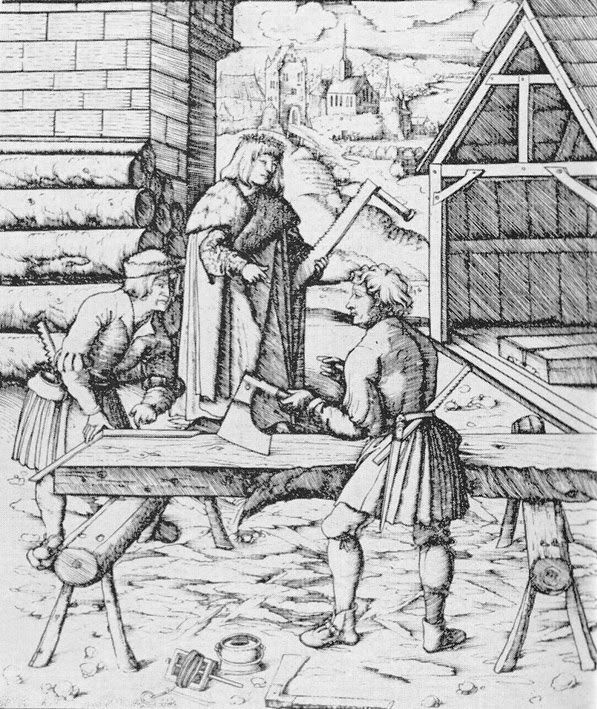
As Ishmael reported to us in the last chapter, the carptenter is nigh-on omnicompetent when it comes to the creation and manipulation of physical objects. The leg he creates is a perfect replica of the bones of Ahab’s old leg. This is no mere peg for his captain to swing around on! It’s a work of art, perfectly proportioned and weighted and with all the bells and whistles that Ahab might demand.
He cannot understand any of the mystical hoseshit that Ahab is spouting, and just dismisses it all. Whatever, none of his business, the captain’s weird, but that’s fine, he’s good at his job, and has other stuff going on, I’m sure there are reasons there, just not for me to know.
Indeed, the carpenter considers himself in a different, lower class compared to people like the great Captain Ahab.
Then, a short, little old body like me, should never undertake to wade out into deep waters with tall, heron-built captains; the water chucks you under the chin pretty quick, and there’s a great cry for life-boats. And here’s the heron’s leg! long and slim, sure enough! Now, for most folks one pair of legs lasts a lifetime, and that must be because they use them mercifully, as a tender-hearted old lady uses her roly-poly old coach-horses. But Ahab; oh he’s a hard driver. Look, driven one leg to death, and spavined the other for life, and now wears out bone legs by the cord.
Other people are out there thinking great thoughts, having grand ambitions, philosophizing and performing epic deeds, but not him. The carpenter is content to concern himself only with practical matters, just getting on with completing his effortlessly masterful work.
This seems perfectly in keeping with the characterization we got from Ishmael in the last chapter. This man only cares about what he’s doing. Very down-to-earth, utilitarian, and… stolid. He has no illusions about his station, he has no desire for great wealth or class, and he has no time for philosophy or mysticism.
Salvation as a perfectly ordinary and mechanical action, that’s what he represents, I believe. It is not some grand, deep metaphor, but rather a very simple one: there is something that needs fixing, and he’s the one to do it. Very straightforward, like the man himself.
The Mystic
Okay, so what is Ahab on about in this chapter?
Well, I already showed you his designs for a new, better human. A combination of mastery of the physical world outside of his body, with only senses and knowledge to grasp its internal workinds. No eyes, but acres of brain, and a skylight to aid in introspection.
This is, of course, all that Ahab desires for himself at this moment. The ability to engage in a herculean physical task, while at the same time grappling with these great emotional and philosophical problems that roil within his own brain. He’s done with the outside world, trying to understand it, and only cares about what’s going on with himself.

Or, one could read is as what Ahab desires of his fellow men as well: perfect slaves able to be read and understood like a book, capable of great physical feats (rowing, harpooning, etc), but with no vision to see the world on their own. Reliant on him for everything. But I tend towards the first interpretation, he is so consumed with his monomania that he concerns himself only with himself, and how he might best accomplish his quest, alone if necessary.
Anyway, the two other big points from him are the unseen world that haunts us all, and the connections that draw all of mankind together. Somwhat related, but not entirely so.
The point of Ahab telling the carpenter about his phantom limb syndrome is not merely to complain about the pain he’s feeling. Far from it! But instead, he is trying to get the carpenter to see a larger picture about the world, and to see beyond the things directly before his eyes.
Hist, then. How dost thou know that some entire, living, thinking thing may not be invisibly and uninterpenetratingly standing precisely where thou now standest; aye, and standing there in thy spite? In thy most solitary hours, then, dost thou not fear eavesdroppers? Hold, don’t speak! And if I still feel the smart of my crushed leg, though it be now so long dissolved; then, why mayst not thou, carpenter, feel the fiery pains of hell for ever, and without a body? Hah!
Ahab is trying to impart on this simple man the depth of hidden reality that exists around him. These are no mere phantoms, but as real to Ahab as anything else in the world! If he can feel his amputated leg as though it were still there, if the soul of that leg lingers yet, then who knows what else might exist all around them, at all times, in this other plane of reality?
Inter-Indebtedness
The part I find most fascinating, though, is the final bit of Ahab’s soliloquy, before he departs the scene:
Oh, Life! Here I am, proud as Greek god, and yet standing debtor to this blockhead for a bone to stand on! Cursed be that mortal inter-indebtedness which will not do away with ledgers. I would be free as air; and I’m down in the whole world’s books. I am so rich, I could have given bid for bid with the wealthiest Prætorians at the auction of the Roman empire (which was the world’s); and yet I owe for the flesh in the tongue I brag with. By heavens! I’ll get a crucible, and into it, and dissolve myself down to one small, compendious vertebra. So.
This strikes me as a very familar school of thought, found in libertarian types to this very day, especially those involved in the tech sector of the economy.
What is all of this recent hullabaloo about AI but an attempt to sell freedom from ones fellow man? True independence, true autonomy, is never having to even think about another human being. Even with all his riches and all his personal power and charisma, Ahab still must rely on the carpenter, and the rest of the crew, at the end of the day.
Modern infrastructure works the same way, of course. It’s a collective action problem, which people will never cease trying to solve with individual solutions, no matter how little sense it makes. It is possible for us to have the society which we do only because people work together and tirelessly maintain systems that are simple public goods, and generate no profit of their own.
Rather than appreciation this grand web of human connection, it is dismissed as “inter-indebtedness”. We all owe each other a great debt, which can never be cleared from the ledger! Even the richest man is no better than a debtor in jail, taken from 10,000 feet.
But the other thing that’s interesting here is this: Ahab himself sees that he is not yet complete. He is not yet a perfect, ideologically pure entity which would be capable of performing his stated task. The doubts still haunt him, the imperfections of his legend. His leg must be mended by a simple carpenter, he still doubts that he may succeed, perhaps in a self-fulfilling prophecy.
As we will see in coming chapters, Ahab is actually not yet completely gone! There is a scrap of humanity left in his old hulk of a body. He is but a mere human, not a perfect weapon forged to kill something beyond human knowledge. His grasping for the infinite is a form of self-negation, and he regrets that it is not yet further along.
Aw yeah, we’re really in it now. As the story comes to a close, the focus will more and more turn to the famous captain of the Pequod. Not that the focus has ever really been off of him since he came on the scene, so long ago, but in a different way now. His actual thoughts and actions, at least as far as Old Ishmael can imagine them.
Well, that’s two in a row! Let us see if I can keep this streak alive. That is, if I can bring myself to pull away from the hypnotic wiles of Balatro long enough to type these up, heheh.
Until next time, shipmates!
Post-script: WAIT I forgot to mention, this chapter contains one of my absolute favorite quotations in the whole book! And somehow it wasn’t one of the bits I quoted. Here it is:
Ha! that’s the heel; we are in luck; here he comes, or it’s somebody else, that’s certain.
I could write ten thousand more words on this… the nature of certainty… the perfect Yogi Berra nature of it… but I will let it stand alone.

 The Beige Moth
Thanks for help again with interpreting those chapters, a lot of interesting takes!
Also “uninterpenetratingly”. Well THAT’S a word. Still not quite sure what it means, so I’m left with loving it unconditionally.
LikeLike