
Now that we’ve got church out of the way, it’s time to get real chummy with some dudes just bein’ bros. Just a real couple o’ old pals, pallin’ around! That’s it and that’s all, certainly no subtext here, no sirree.

These next few chapters make an interesting counterpoint to the harsh, literally sermonizing tone of the last little run. It’s a nice change of pace.
SUMMARY: Ishmael gets back to the Spouter-Inn, and finds Queequeg examining a book at the dining room table, counting its pages in awe. Ishmael decides to become friends with Queequeg, and strikes up a conversation. Queequeg is very receptive, and quickly declares them married, and after a while they go on up to their room. Queequeg divides his money evenly, giving half to Ishmael, they then get in bed together and share their deepest secrets with one another, as married couples are wont to do.

So, I mentioned before, back in The Counterpane, that there are a few parts in Moby-Dick; or, the Whale that could be construed, by modern readers, as a bit homoerotic. Queequeg sleeping with his arm around Ishmael, sure, that’s a little gay, but this chapter, hoo boy, there’s really no other way to read it than a budding romance.
I mean, let’s take it point by point. First, Ishmael finds himself merely interested in this strange “savage” who he was forced to sleep with the night before. But as he gazes at him, he takes note of his handsomeness, the fine shape of his head. He delves into phrenology and says that “Queequeg was George Washington cannibalistically developed.“
Phrenology is a pseudoscientific theory from the 19th century that posited that the shape of the head indicated the shape of the brain, which, naturally, determined your personality. You could use some calipers to measure the lumps on a skull and tell if someone was a criminal, by the size of their Crime Organ. It’s pretty interesting, and all obvious hogwash, perfect material for the Sawbones podcast, one of my favorites, who have of course done an episode on it.
Let’s not beat around the bush, Ishmael is secretly checking out Queequeg while pretending to watch the storm outside, “Whilst I was thus closely scanning him, half-pretending meanwhile to be looking out at the storm from the casement.” He is enamored with the stoic personality of his bedfellow, the way he goes through life perfectly self-aware and ease with his own existence, warts and all. Even so very far from his homeland, among these people who must seem so strange to him, Queequeg never falters!

Also this passage, which I take as a personal attack on myself:
Surely this was a touch of fine philosophy; though no doubt he had never heard there was such a thing as that. But, perhaps, to be true philosophers, we mortals should not be conscious of so living or so striving. So soon as I hear that such or such a man gives himself out for a philosopher, I conclude that, like the dyspeptic old woman, he must have “broken his digester.”
And then, and he continues to stare longingly, we get this line
I began to be sensible of strange feelings. I felt a melting in me. No more my splintered heart and maddened hand were turned against the wolfish world.
Ishmael is just falling head over heels in love with Queequeg. He’s got a crush. There is simply no other way to read it, I’m sorry. Ishmael throws away all doubts relating to Queequeg’s origins, decides that since he hasn’t found any true kindness among his fellow christians, he’ll try being friends with a pagan.

There have been some hints and indications of it, but Ishmael is remarkably open-minded and tolerant for a man in the early 19th century. Indeed, after he finally works up the courage to start chatting with Queequeg and they share a smoke, get hitched, and go back to their room, Ishmael has no problem literally worshiping an idol with his best pal.
I really love the logic he uses for it:
I was a good Christian; born and bred in the bosom of the infallible Presbyterian Church. How then could I unite with this wild idolator in worshipping his piece of wood? But what is worship? thought I. Do you suppose now, Ishmael, that the magnanimous God of heaven and earth—pagans and all included—can possibly be jealous of an insignificant bit of black wood? Impossible! But what is worship?—to do the will of God—that is worship. And what is the will of God?—to do to my fellow man what I would have my fellow man to do to me—that is the will of God. Now, Queequeg is my fellow man. And what do I wish that this Queequeg would do to me? Why, unite with me in my particular Presbyterian form of worship. Consequently, I must then unite with him in his; ergo, I must turn idolator.
It’s hard to argue, frankly. A lot of the logic of religion is rooted in more ancient practices that are based in more polytheistic understandings of the world. You’re only supposed to worship your god because you’re on their team, essentially. But if you really believe that your god is the only real one, and all powerful, and all knowing, then why should they be so jealous of your worship? Would they really be so petty as to punish you for being kind to a friend?
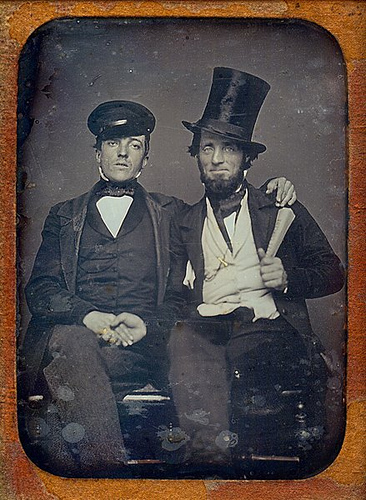
Now, as the new married couple settle in to bed for the next chapter, I will entertain some argument about their status as clear and obvious homosexual lovers. There’s nothing explicit here, of course, and I hear you saying that friendship was different in those days.
Long, long ago, before modern society, there was a strange place called The Past, and they have strange habits and customs that look odd to our modern eyes. We may see some men hugging each other, being physically intimate, and think “goodness, how homoerotic!” But, in that time, it was simply more acceptable for men to express physical affection for one another with no sexual subtext whatsoever. They were, in fact, just dudes bein’ bros. Or companions being bosom chums, whatever the 19th century equivalent phrase is.
So what I am reading as something more than friendship was actually just that, and would have been understood to be that at the time.
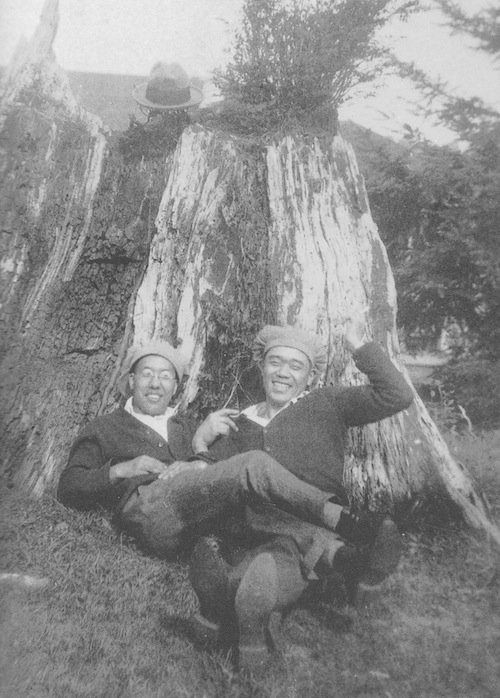
But I say to you: Yes, things were different in the past, but that cuts both ways! You simply could not speak openly about these things, which were especially common among sailors. There is a famous saying, that the traditions of the Royal Navy amount to “rum, buggery, and the lash” (or something like that). Men cooped up together on a ship for months and months, it’s no surprise, frankly. And there’s no way that Melville, who was a sailor for his entire youth (even if he only went on one whaling voyage) would be naive to these facts.
The language employed in this chapter, I posit, frames this more as a crush and budding romance than anything else. If Melville intended a mere close friendship, he could have written it differently, and who cares what he intended anyway, he’s not around to argue. Interpretation is creative! I say: they’re gay, and make a good couple.
Ah, if this were a serious bit of writing, I would go track down some more sources to cite and whatnot, really develop a strong argument. But hey, I’m just havin’ fun here, not doin’ this for a grade. So you’ll just have to take my word for it.
Up next, The Nightgown, in which we get an intimate portrait of the young lovers in bed, and one of the most #relatable bits in the whole book!
Until next time, shipmates!
Image Credits:
First four from this article, last two from this one. All anonymous photos.

 The Beige Moth
yes, i agree super gay chater. Also love the logic behind Ismael for idolizing with Queequeg.
They are both up this point really interesting characters. And from what i remember even tho Ismael kind of dissappears later, Queequeg would turn out to be one of the most important characters.
Now, changing the subject, what is the place of women in this novel? I really cant think of a single woman appearing for now at least. Im not saying it as good or bad because thats not what i believe is important to discuss here because you know it can be like that. One of the ten best film in history “The Thing” does not have a single women in it. But i digress. Is there a place for women in the world of the novel? And what is that place? Even Biblically there is no place or mention yet. Or mythically or simbolic. Except we adress the femenine figures as only the simbolic ones like the sea could be and the whale. Even tho i-ve read stuff about moby dick being male so i dont know about that yet. But the place for women which if not talk about explicitly by Melville then it means it is important. Some times what you dont even mention is as important or more aa what you mention all the time. So, women. What about them? Will keep reading and think about that.
-Jesús
LikeLiked by 1 person
As a heterosexual man, I find the relationship between Ishmael and Queequeg (IQ) to be an incredible model for my marriage and also my closest friendship which is with another woman. The ways in which my circumstances have come to resemble being twice married (not actually, nor am I cheating on my wife, nor will I ever hurt two women I love by doing so) have had me thinking a lot about the taboo marriage of IQ both in terms of my own life and several works that influenced Melville. In quick succession, the truth of friendship is defined. Mutual admiration and attraction is established, the relationship is defined in intimate terms, sustenance and quality of life become shared with no regard to “fairness”, and plans are made for futures present in each other’s lives.
I’m reminded first of Measure for Measure, the action of which is instigated by pregnancy out of wedlock. A main character is sentenced to death even though he is promised to marry the woman, intends to marry, and only can’t due to external circumstances of ritual. Shakespeare describes this as “true marriage”, in which the sin of extramarital sex does not accrue in the eyes of the church unless the couple breaks off their marriage intention. The shared theme is that true marriage happens in the heart and in the actions of partners, rather than the legal institution. Measure for Measure further contrasts this behavior with the hypocritical and licentious acting duke.
In Frankenstein, Robert Walton expresses desire for a friend that seems suspiciously close to what IQ share. This friend would be his soul’s twin and fulfill his heart and help bear emotional burdens, for the duration of life. The monster further desires this sense of community, friendship, and intimacy as his story to his creator shows.
Both of these and Moby Dick, to me, connect through paradise lost, in which the unfallen relationship between adam and eve is so completely transparent due to their inability to sin against one another, nor perceive that one could be hurt by the other. After the fall, they must cover themselves from each other in both heart and body. In effect, the desire for friendship and marriage is the quest to peel back original sin and feel complete connection.
As my friendship with this other woman has deepened, my wife and I have essentially undertaken to offer resources of emotion, sustenance, and promises to do so whenever able and called upon- similarly to the IQ marriage. I have actually come to realize that outside of people with my last name, I have only had approximately two friends in my life- so many that I have called friends have disappeared or I was uncomfortable to place reliance in them or they turned out unreliable.
In summary, the queerness of IQ is very important to me as I navigate my own messy and unofficial, albeit heterosexual, internal romantic life.
LikeLiked by 1 person